
Why Do Students Forget Most of What They Learn?
Introduction
A teacher explains something carefully.
Students listen.
They practice.
They answer correctly.
They complete the assignment.
They may even perform well on the test.
Then several weeks later, the teacher asks about the same concept.
Silence.
Confusion.
Someone says:
“I don’t remember learning that.”
For educators, this can be discouraging.
Hours were spent preparing the lesson.
Students appeared to understand.
The assessment suggested that learning had happened.
So where did the knowledge go?
Forgetting is not always evidence that teaching failed.
Human memory was never designed to preserve every detail we encounter.
The mind continually receives more information than it can permanently retain.
Some things are noticed briefly.
Some remain long enough to complete a task.
Some become deeply connected to existing understanding.
Some are revisited often enough to become durable.
And much disappears.
This means an important distinction must be made:
Being exposed to information is not the same as learning it deeply enough to remember it.
Scripture repeatedly emphasizes the importance of remembering precisely because human beings are so capable of forgetting.
Moses warned Israel:
“Only take heed to thyself, and keep thy soul diligently, lest thou forget the things which thine eyes have seen…”
— Deuteronomy 4:9, KJV
The warning reveals something timeless.
Important truth can be encountered.
Understood.
Experienced.
And still forgotten.
So the educator’s task is not merely to present information.
It is to help important learning become strong enough to remain.
Students Forget Because Attention Was Never Fully Present
Sometimes what appears to be forgetting is actually incomplete learning from the beginning.
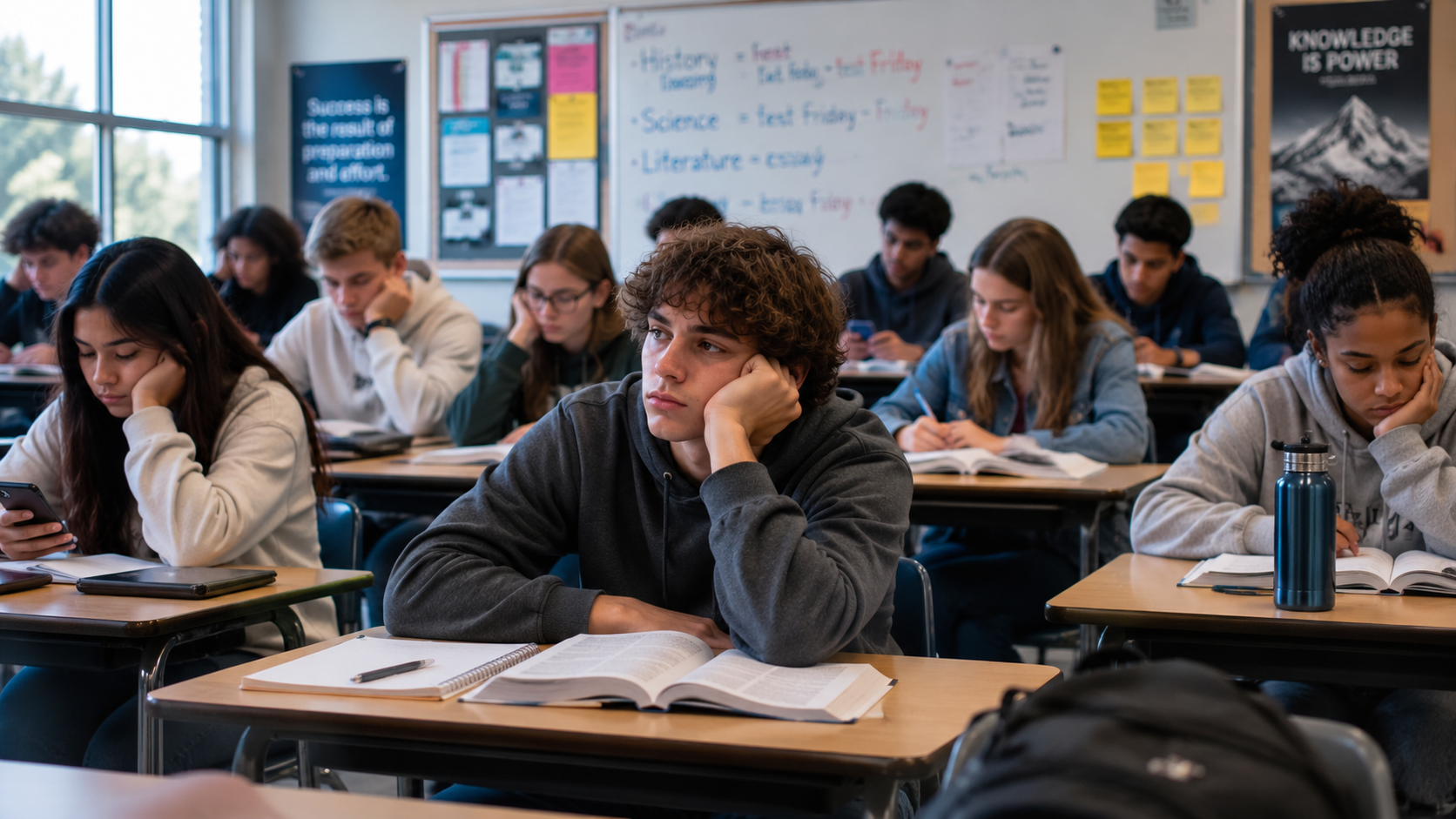
The student was physically present.
But mentally?
Perhaps not.
They were thinking about something that happened earlier.
Watching the clock.
Checking a device.
Talking quietly.
Worrying.
Daydreaming.
Trying to follow while exhausted.
Information passed through the room without receiving enough attention to become strongly encoded.
Proverbs says:
“My son, attend to my words; incline thine ear unto my sayings.”
— Proverbs 4:20, KJV
Attention comes before retention.
This does not mean teachers must entertain students continuously.
Learning requires students to develop the discipline of attention.
But educators can help.
Reduce unnecessary distraction.
Clarify what matters.
Use questions.
Create intellectual curiosity.
Pause before important ideas.
Connect new information with something meaningful.
A student cannot remember deeply what was barely noticed.
Students Forget Because They Learned for the Test
There is a kind of learning designed primarily to survive until assessment.
Memorize.
Repeat.
Test.
Forget.
The student asks:
“What do I need to know for the exam?”
That question is understandable.
But it can produce shallow learning if the goal becomes merely short-term performance.
Information is held long enough to reproduce it.
Then, once the examination is finished, the mind has little reason to retain it.
The problem is not testing itself.
Assessment can reveal understanding and strengthen retrieval.
The problem is when the test becomes the final purpose of learning.
Ecclesiastes says:
“The wise man’s eyes are in his head…”
— Ecclesiastes 2:14, KJV
Wisdom sees beyond the immediate moment.
Educators can help students look beyond:
“Will this be on the test?”
toward:
“Why is this worth understanding?”
When knowledge has purpose beyond assessment, students have more reason to retain it.
Students Forget Because Information Was Never Connected
Imagine trying to hang something on a wall with no hook.
It falls.
New information can behave similarly.
If students have nothing to connect it to, knowledge remains isolated.
A date without historical context.
A formula without conceptual understanding.
A vocabulary word without meaningful use.
A biblical passage without understanding its setting.
Facts may be memorized temporarily, but isolated information is difficult to preserve.
Jesus frequently connected unfamiliar truth with familiar life.
A farmer sowing seed.
A woman searching for a coin.
A shepherd looking for a sheep.
A fisherman casting a net.
People already understood these realities.
Jesus used them as bridges.
Effective teaching often does the same.
Before introducing something new, ask:
“What do students already know that could support this?”
Then make the connection visible.
The stronger the network of understanding, the more places new knowledge has to attach.
Students Forget Because They Recognize Instead of Recall
A student rereads notes.
Everything looks familiar.
“Yes, I know this.”
Then the notes are closed.
“Explain it.”
Suddenly the knowledge disappears.
Why?
Because recognition and recall are different.
Seeing something again can create the feeling of knowing.
But durable learning requires the ability to retrieve information without the answer being visible.
Scripture repeatedly calls God’s people to active remembrance:
“Remember the days of old, consider the years of many generations…”
— Deuteronomy 32:7, KJV
Remembering is active.
Students need opportunities to retrieve what they learned.
Not only reread it.
Ask:
“What did we learn yesterday?”
“Explain this without looking at your notes.”
“What were the three main ideas?”
“Can you solve this without the example?”
“What happened in the previous chapter?”
Retrieval may feel harder than rereading.
That difficulty is useful.
The effort of remembering strengthens memory.
Students Forget Because They Encounter Something Only Once
A powerful lesson can still fade.
Students may understand something beautifully today and remember surprisingly little several months later.
Learning needs return.
Scripture repeatedly describes truth being taught again and again.
Moses instructed Israel:
“And thou shalt teach them diligently unto thy children, and shalt talk of them when thou sittest in thine house, and when thou walkest by the way…”
— Deuteronomy 6:7, KJV
Truth was not confined to one lesson.
It returned across ordinary life.
Education often moves in the opposite direction.
Unit one.
Finished.
Unit two.
Finished.
Unit three.
Previous knowledge rarely returns.
Students understandably conclude:
We are done with that.
But important knowledge should not disappear when the chapter closes.
Bring it back.
Days later.
Weeks later.
In another context.
Use old knowledge to understand new knowledge.
What returns is more likely to remain.
Students Forget Because Too Much Is Treated as Equally Important
Curricula contain enormous amounts of information.
Teachers feel pressure to cover everything.
Students receive:
Definitions.
Examples.
Details.
Exceptions.
Dates.
Processes.
Concepts.
Instructions.
When everything is presented with equal emphasis, students may struggle to distinguish the essential from the secondary.
The result can be strange.
They remember an amusing example but forget the principle it illustrated.
Remember a minor detail but lose the central concept.
Good teaching creates hierarchy.
Ask:
If students remember only three things from this unit five years from now, what should those three things be?
Those ideas deserve repetition.
Application.
Connection.
Retrieval.
Reflection.
Jesus often returned to central truths.
Love God.
Love one another.
Follow Me.
Abide.
Believe.
Watch.
Serve.
Forgive.
The repetition communicated importance.
Educators should make essential learning unmistakable.
Students Forget Because They Do Not Use What They Learn
Knowledge that is never used becomes difficult to maintain.
A language learned but never spoken fades.
A mathematical procedure never practiced becomes uncertain.
A skill unused for years becomes rusty.
Learning becomes more durable when students repeatedly apply it.
James says:
“But be ye doers of the word, and not hearers only…”
— James 1:22, KJV
Truth becomes connected with action.
In education, application gives knowledge purpose.
Do not only teach persuasive writing.
Let students persuade a real audience.
Do not only teach measurement.
Let students measure something meaningful.
Do not only teach research.
Let students investigate a genuine question.
Do not only teach conflict resolution.
Let students practice resolving appropriate conflicts.
Knowledge used becomes knowledge strengthened.
Students Forget Because They Never Explain What They Know
Students can sometimes reproduce information without truly organizing it.
Ask them to explain the idea to someone else, however, and weaknesses appear.
Teaching requires understanding.
What is the main idea?
How do the pieces connect?
Which example would make this clearer?
Why does this matter?
Paul describes knowledge being passed from one learner to another:
“…the same commit thou to faithful men, who shall be able to teach others also.”
— 2 Timothy 2:2, KJV
One person learns.
Then teaches.
Then another teaches.
Explanation strengthens understanding because it forces the learner to reorganize knowledge.
Try asking:
“Explain this as if you were teaching a younger student.”
“Explain why the answer is correct.”
“Explain this without using the textbook’s definition.”
“Teach your partner the concept.”
When students struggle to explain something, educators have discovered where learning needs strengthening.
Students Forget Because They Never Think About Their Thinking
Many students finish tasks without reflecting upon what happened.
Assignment submitted.
Lesson finished.
Test completed.
Next.
But reflection helps learning settle.
What did I understand?
What was difficult?
Where did I make mistakes?
What strategy helped?
What still confuses me?
What would I do differently?
Scripture often portrays reflection as part of wisdom.
The psalmist says:
“I will meditate in thy precepts, and have respect unto thy ways.”
— Psalm 119:15, KJV
Meditation means truth is not merely encountered and abandoned.
It is considered.
Returned to.
Processed.
Even a brief classroom reflection can help.
“What is one thing you understand now that you did not understand before?”
“What mistake taught you something today?”
“What question are you leaving with?”
These questions turn activity into awareness.
Students Forget Because They Are Overloaded
Sometimes the problem is not lack of effort.
It is too much information arriving too quickly.
Teachers know the subject deeply.
Students do not.
What feels like a manageable explanation to an expert may feel like a flood to a beginner.
Too many new terms.
Too many steps.
Too many instructions.
Too many concepts introduced simultaneously.
Students may follow temporarily but fail to build a stable mental structure.
Jesus told His disciples:
“I have yet many things to say unto you, but ye cannot bear them now.”
— John 16:12, KJV
That statement reveals remarkable instructional wisdom.
There was more truth.
But they were not ready to carry it yet.
More is not always better.
Sometimes excellent teaching means deciding what not to introduce yet.
Teach enough for understanding.
Then build.
Students Forget Because They Lack Foundational Knowledge
Sometimes a learner appears to be struggling with today’s lesson when the real problem began much earlier.
A student cannot understand the equation because foundational mathematics is weak.
Cannot comprehend the text because vocabulary is insufficient.
Cannot follow the historical argument because basic chronology is missing.
New learning depends upon prior knowledge.
When the foundation contains gaps, new material has difficulty attaching.
Jesus once asked:
“Have ye not read…?”
— Matthew 19:4, KJV
The question assumes prior knowledge matters for present understanding.
When students repeatedly forget or struggle, educators should sometimes look backward rather than simply reteach the current lesson more loudly.
Ask:
What does this student need to know before this can make sense?
Repairing the foundation may solve what appeared to be a memory problem.
Students Forget Because Meaning Was Missing
We remember what matters to us more easily than what feels arbitrary.
A student may struggle to remember ten disconnected facts but effortlessly remember complex information about a subject they love.
Why?
Meaning organizes attention.
It gives information significance.
This does not mean every lesson must become personally exciting.
Students need discipline to learn things whose importance they do not yet understand.
But educators can help reveal meaning.
Why does this matter?
Where does it fit?
What problem does it solve?
What does it help us understand?
How does it connect to human life?
Solomon wrote:
“Wisdom is the principal thing; therefore get wisdom…”
— Proverbs 4:7, KJV
Knowledge becomes more memorable when students understand its place within something larger.
Students Forget Because Emotion Can Interfere With Learning
A student may appear inattentive when the deeper issue is anxiety.
Conflict at home.
Fear.
Grief.
Embarrassment.
Exhaustion.
Social pressure.
Hunger.
A mind preoccupied with survival or distress has less capacity available for academic learning.
This does not mean educators can solve every difficulty students carry.
They cannot.
But it reminds us that learners are whole people.
Jesus repeatedly noticed people before addressing tasks.
He saw hunger.
Grief.
Fear.
Confusion.
Need.
Compassion shaped His response.
Teachers likewise benefit from asking occasionally:
Is this student unwilling to learn—or currently struggling to be available for learning?
The answer may change the response.
Forgetting Can Actually Help Reveal What Matters
Forgetting is not entirely an enemy.
It forces educators to identify what deserves return.
If students remembered everything automatically, teaching could become simple exposure.
But because memory fades, important knowledge must be deliberately strengthened.
Forgetting asks:
Was this important enough to revisit?
Did students truly understand it?
Can they retrieve it?
Can they use it?
Does it connect with anything else?
Sometimes forgetting reveals that what looked like learning was only temporary performance.
That information is useful.
It gives educators a chance to teach differently.
Forgetting Is Reduced When Students Encounter Ideas in Different Ways
An important concept can be:
Explained.
Discussed.
Drawn.
Applied.
Compared.
Questioned.
Written about.
Demonstrated.
Taught to someone else.
Encountered in a story.
Used to solve a problem.
Different encounters create additional pathways back to the same idea.
Jesus often taught important truths through multiple forms.
Direct instruction.
Parables.
Questions.
Objects.
Experiences.
Miracles.
Conversations.
The disciples encountered principles repeatedly from different directions.
Variation prevents repetition from becoming merely mechanical.
Students are not simply hearing the same sentence again.
They are deepening the same understanding.
Forgetting Decreases When Knowledge Becomes Part of a Larger Story
Disconnected information is difficult to remember.
Stories provide structure.
Beginning.
Development.
Conflict.
Cause.
Consequence.
Resolution.
This is one reason historical narratives, case studies, biographies, and biblical accounts can become memorable.
Scripture itself repeatedly tells God’s people to remember their story.
Who they were.
What God had done.
Where He had led them.
Psalm 78 says:
“We will not hide them from their children, shewing to the generation to come the praises of the Lord…”
— Psalm 78:4, KJV
Truth was carried through remembered history.
Educators can ask:
What larger story does this information belong to?
A scientific discovery has a story.
A mathematical idea has a history.
A social change has causes and consequences.
A literary work belongs to human questions larger than itself.
Story helps information become coherent.
Forgetting Is Different From Never Having Learned
This distinction matters.
A student may have genuinely understood something and later lose easy access to it.
That is forgetting.
Another student may have appeared successful without ever developing real understanding.
That is different.
Assessment should therefore go beyond immediate performance.
Ask students to explain.
Apply.
Transfer.
Retrieve later.
Use knowledge in unfamiliar contexts.
These tasks reveal whether learning has depth.
A correct answer today does not always mean durable understanding has formed.
The educator’s question should not only be:
“Can they do it now?”
but also:
“What am I doing so they can still use this later?”
Christian Education Must Remember That Spiritual Truth Can Also Be Forgotten
For Christian educators, forgetting has an even deeper dimension.
Students can memorize Scripture and still forget its truth when life becomes difficult.
They can know that God is faithful and panic as though He were absent.
Know that forgiveness matters and hold resentment.
Know that identity is found in Christ and live according to comparison.
Israel repeatedly experienced this.
Psalm 106 says:
“They soon forgat his works; they waited not for his counsel.”
— Psalm 106:13, KJV
They had seen God’s works.
The problem was not lack of evidence.
They forgot.
This is why spiritual education cannot be reduced to biblical information.
Students need repeated remembrance.
God’s character.
God’s works.
God’s promises.
The gospel.
Their dependence upon Christ.
Truth must return again and again because human hearts forget more than facts.
We forget what we once knew mattered.
Jesus Used Remembrance Deliberately
Before His death, Jesus gave His disciples a practice built around memory.
Regarding the bread, He said:
“This do in remembrance of me.”
— Luke 22:19, KJV
Remember.
Because even the most important truth needs deliberate remembrance.
Christian educators should take this seriously.
Do not assume that because something foundational was taught once, students no longer need it.
Return to grace.
Return to creation.
Return to redemption.
Return to God’s character.
Return to Christ.
Return to Scripture.
Return not because there is nothing new to teach.
But because some truths are too important to leave behind.
For Educators
Before teaching your next unit, identify the knowledge that students truly need to retain.
Then design for memory from the beginning.
Ask:
What prior knowledge will this connect with?
How will students retrieve it without notes?
How will they explain it?
Where will they use it?
When will it return?
Do not wait until the examination to discover whether students remember.
Begin lessons with retrieval:
“Without opening your notes, what do you remember from yesterday?”
After a week, return again.
After a month, connect the concept to something new.
Also consider reducing content.
If students are forgetting nearly everything, the answer may not be adding more.
Perhaps fewer ideas need deeper attention.
Coverage is not the same as learning.
Reflection
How much of what you teach do students remember several months later?
Are students learning primarily for examinations?
How often do they retrieve information without notes?
Do important concepts return after the unit ends?
Are you presenting too much new information at once?
Do students understand how new knowledge connects with what they already know?
Are they explaining concepts—or mainly recognizing correct answers?
Do they have opportunities to use what they learn?
Is there enough time for reflection?
Which parts of your curriculum are truly essential?
And if students forget many details, what do you most hope they will never forget?
Conclusion
Why do students forget most of what they learn?
Because human memory is selective.
Because attention is limited.
Because some information is learned only temporarily.
Because isolated facts fade.
Because recognition can imitate understanding.
Because unused knowledge weakens.
Because one encounter is rarely enough.
Because overloaded minds cannot organize everything they receive.
Because reflection is often missing.
And because even important truths can disappear when they are not deliberately remembered.
This does not mean educators should become discouraged.
It means we should teach with memory in mind.
Teach less when necessary.
Connect new knowledge to what students already know.
Make essential ideas clear.
Ask students to retrieve rather than merely reread.
Let them explain.
Let them use knowledge.
Return to important ideas over time.
Create space for reflection.
Help them recognize patterns.
And distinguish temporary performance from genuine understanding.
For Christian educators, remembrance carries even greater importance.
Scripture repeatedly tells God’s people:
Remember.
Remember what God has done.
Remember His commandments.
Remember His faithfulness.
Remember His covenant.
Remember Christ.
Because forgetting is not always losing information.
Sometimes it is losing sight of truth that should be shaping the present.
Students may forget many worksheets.
Many definitions.
Many details.
They may forget exactly what was written on the board.
But perhaps years later something deeper will remain.
A way of thinking.
A love of truth.
A habit of asking good questions.
A willingness to examine evidence.
The courage to admit, “I don’t know.”
The discipline to keep learning.
The wisdom to connect knowledge with responsibility.
And above all, the memory of a God whose truth was not merely taught as information but returned to again and again as the foundation of life.
The educator cannot make every lesson unforgettable.
That was never the goal.
The greater task is to recognize what is worth remembering—and teach it deeply enough, often enough, and meaningfully enough that it has a chance to remain.
Continue Growing
→