How Honest Parents Help Children Face Fear With Faith

The nursery lamp is off. Your child’s eyes are closed. And yet your whispered prayer for their faith—“Lord, keep them close”—is tangled with an ache you can’t name. You clutch their small hand, fighting the fear that maybe your words aren’t reaching, that despite all your intention, something vital will slip through your fingers and the next generation’s faith will fade. You recall advice about devotions and boundaries and “making it stick”—but wonder why, beneath every well-meant effort, anxious questions still echo. What if this quiet alarm isn’t just about them, but about us—and how we try to pass on what matters most?
When Our Faith Talks Carry More Than Words
Much of what Christian parents do to ‘pass down faith’ is instinctive. Mealtime prayers. Sunday rushes. Family devotions, sometimes forced, sometimes forgotten. But these visible rhythms often mask a deeper cycle: the transfer not just of beliefs, but of what drives those beliefs—whether tranquil trust or tight-fisted anxiety.
It isn’t the scripted answers or well-rehearsed bedtime routines that form a lasting legacy. Rather, it’s the emotional current beneath our words and actions. If we relate to God like fragile performers—never missing a devotional, never admitting confusion or doubt—our children will learn to do the same. Your son may repeat the Lord’s Prayer, but does he also notice if your shoulders tense when you mention God’s will? Your daughter may memorize Scripture, but does she see what happens when you’re unsure what to say or do? The next generation may say the right things, but inside, the cycle of spiritual tension tightens. They inherit watchfulness—not worship; performance—not peace.
What we transmit is not simply what we teach, but how we live with our own uncertainty. Families quietly absorb—often without language—whether faith is a space for real human need, or a guarded, performative exercise. Left unnamed, unhealed, this pattern quietly reproduces—devout, yet brittle—across generations.
Beneath the Surface: The Hidden Cost of Spiritual Anxiety at Home
Consider the moments between the official routines: the sharp sigh after a failed chore, the worried glance exchanged above a child’s head when hard questions arise, the silent struggle to ‘move on’ from conflict. If beneath every effort to pass on faith there lurks the question, ‘Am I enough to secure their soul?’—then our children will likely learn the same anxiety. Their ears may hear ‘Jesus saves,’ but their hearts absorb ‘Don’t let them see you stumble.’
Even sincere practices can subtly communicate that God is mostly interested in our performance: a hurried prayer only after an argument, a Bible story told primarily to correct behavior, or a discipline that ends with, ‘You know better.’ In these moments, we unintentionally pass on a God who is more to be managed than embraced.
Scripture’s Disruption: Love, Not Perfection, at Faith’s Center
This undercurrent is not new. In Deuteronomy 6:4-9, Moses beckoned Israel into a living, whole-hearted love for God: ‘Hear, O Israel: the LORD our God, the LORD is one. You shall love the LORD your God with all your heart and with all your soul and with all your might.’ Faith is to be woven into life—mealtimes, journeys, doors, and gates—not as a demand for flawlessness, but as the outpouring of a heart already changed by love. The family is pictured not as an anxious moral classroom but as a living ecosystem of worship. Rote words were never enough; God’s desire is for faith to be visible, embodied, and unforced.
Yet it is so easy for even the best families to slip into treating faith as a fragile package to be nervously managed. The Apostle John, in 1 John 4:18-19, confronts the logic of fear directly: ‘There is no fear in love, but perfect love casts out fear. For fear has to do with punishment, and whoever fears has not been perfected in love. We love because he first loved us.’ If the dominant air in our homes is spiritual anxiety—dread of getting it wrong, of spiritual drift, of letting God or our church community down—then, no matter our intentions, we pass on a shadow of the gospel, not its substance. Fear becomes the secret legacy, and children sense it deeply, sometimes long before they can name it.
Paul, in Colossians 3:12-17, gives families a vision for something altogether different: ‘clothe yourselves with compassion, kindness, humility, gentleness and patience… Bear with each other and forgive one another… And let the peace of Christ rule in your hearts.’ The command isn’t toward anxious management, but persistent, gracious presence. Here, spiritual formation is neither a performance nor a hiding place for shame, but an invitation to let Christ’s peace, not our anxieties, be the atmosphere in which faith grows.
The Gospel Lived Out: Christ’s Vulnerability and the Model We Follow
The Gospel subverts our assumption that we must always be strong for our children. In the Gospels, Jesus expresses not only divine authority but humble openness. He weeps at Lazarus’s tomb, grieves in the garden, and admits anguish before the cross. He does not pass down spiritual pressure but takes all our fear-driven striving into Himself. He welcomes children, not as projects, but as precious persons who need grace as much as any adult. At the cross, the Son doesn’t transmit an inheritance of pressure—He invites us into God’s heart, where real healing can finally begin.
When Christian parents confess their weakness and need for Christ openly with their children, something transformative happens. The mask of untouchable certainty lifts. A child who sees their parent admit, ‘I was sharp with my words tonight—I need Jesus just as much as you,’ receives a gift far more durable than spiritual scripting. Visible dependence becomes the truest seed of resilient, honest, grace-rooted faith.
Rewriting Family Culture: Practical Rituals of Confession and Repair
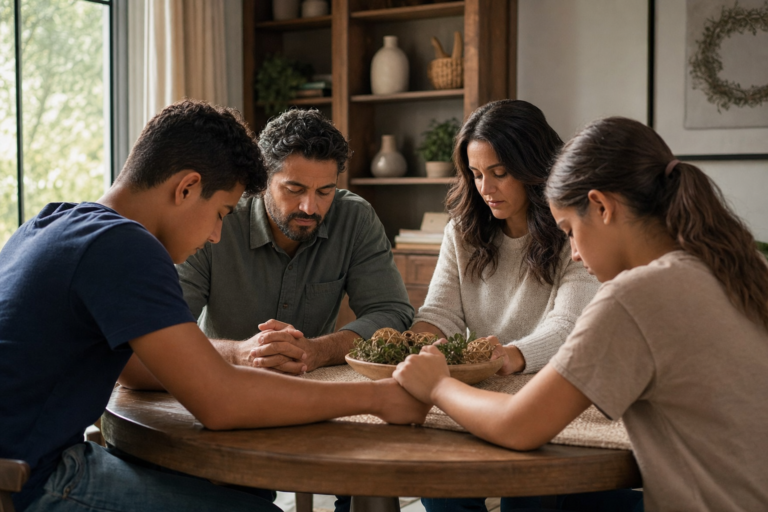
Imagine this: Two families bow their heads for supper. In one, the mood is tense after a day of missed deadlines and short tempers. A parent leads a prayer, but the unspoken wounds remain, and spiritual language feels like a veneer. In the other, the struggle is named: ‘Tonight was hard for me. I was impatient, but I want us to learn what to do with our rough edges. Can we ask Jesus to help us start fresh?’ Conversation opens. Vulnerability links generations in authentic trust.
This is not a technique—it’s a posture put into practice. Concrete habits help it root:
- Visible Parental Confession: Let parents admit—sometimes at the table or bedtime—real moments of failure. ‘I missed it here…I need Jesus right now.’
- Shared Prayers of Need: Shift from only praying for children to praying with them about the family’s whole need. Children are invited to bring their own fears and confessions aloud, and Christ’s grace is named as the constant anchor.
- Scheduled Repair Spaces: Make space (perhaps weekly) for mutual confession—around the table, during bedtime, or on walks—giving everyone a chance (adults included) to name what didn’t go well, ask forgiveness, and invite Christ in.
- Reframing Faith Language: Leave behind ‘Did you obey?’ as the prevailing test. Try, ‘Where do we all need Jesus today?’ or, ‘Let’s ask for help—He is not tired of us.’
Family faith transmission is not about minimizing sin or ignoring standards, but about normalizing a home where the most spiritual thing you can say is sometimes, ‘I was wrong, and I need Christ’s help.’
Does Vulnerability Invite Chaos or Build Strength?
A natural concern arises: If families allow parental weakness and stop projecting certainty, won’t that undermine faith, give room for sin, or leave children adrift? The witness of Scripture and lived experience say otherwise. Children are already experts at hypocrisy detection, especially in the digital and performative age. Faith built on secrecy or anxious vigilance is usually brittle. In contrast, faith modeled through visible reliance and ongoing repair invites responsibility and courage: ‘We keep returning to Christ together.’
Even when children drift, they are drawn back less by memories of control or relentless devotionals, and more by the recollection of parental humility, honesty, and grace. Many prodigals return not to a doctrine, but to a home remembered as a place of open welcome and truth-telling, where Christ’s love was not a hidden concept but the family’s lifeline in daily messiness.
If anger has wounded, or discipline has crossed into discouragement, the way forward is not stricter rules but joint return—to kneel together and allow Christ’s peace to repair what’s broken. Colossians 3 does not envision a family without failure, but a culture in which every wound is eventually drawn into the light, into forgiveness, and into the ongoing work of Christ’s redemption.
Hope for Scarred Legacies: Returning Is the Brightest Inheritance
What if fear already rules? What if your family story is already scarred—secrecy, performance, distrust? You are not disqualified. The Bible’s brightest generational stories are those where repentance and renewal reshaped the future. Kingdom legacy is not perfection but becoming a family of returners. It may start as a faltering whisper—a parent to a teen: ‘I regret how much I tried to manage your faith. I need to rediscover grace alongside you.’
Small, awkward acts of admission and prayer remake the atmosphere—at the kitchen table, in the car, during walks in the park. Each return to Christ together lays another brick in a culture of trust. Over time, new growth overtakes the old trauma; simple, honest Christ-dependence gradually outshines the brittle legacy of performance or fear.
Kneeling Side by Side: The Legacy That Lasts
Our greatest inheritance is not a set of polished spiritual routines, but a pattern of humility, dependence, and delight in Christ. It is written in ordinary moments: a parent kneeling beside—not above—their child, both whispering a shared need and opening hands to receive Christ’s love afresh. It is seen at the dinner table, where the old cycle of fear is broken by honest laughter, mutual admission of need, and confidence that Jesus—not parental performance—is the anchor each generation needs.
This is no dismissal of convictions or holy standards, but the only true way convictions are passed down: lived, confessed, and continually re-rooted in Jesus Himself. In these invisible, often awkward acts of gathered dependence, faith becomes rooted so deeply it can weather storms long after the routines are forgotten.
The cycle of fear can end, not through flawless achievement but through a legacy of kneeling. The next chapter—honest, courageous, Christ-centered trust—waits at the threshold of vulnerability. Start tonight: whisper your need, aloud, in your child’s hearing. The living Christ is not embarrassed by your imperfection. He will meet your family there.