Helping Children Find Their Place in God’s Story
The colored paper figures are carefully arranged: Abraham with his staff, Ruth standing tall, Peter holding a net wide and strong. In the corner—a shadow of a child, sketched by quiet fingers, eyes lowered. When asked why she placed herself at the page’s edge, the little artist shrugs: “I love what God did for them. But does God do stories with kids like me?”
The Quiet Gap: When Bible Stories Leave Children on the Margin
It’s a scenario more common than most adults realize. Children often become expert narrators of ancient miracles, bold faith, and impossible victories—yet sense, deep down, that their ordinary lives unfold in the empty space between those dazzling episodes. The Bible’s drama feels settled, with the best lines already spoken by giants of faith. All that’s left, it seems, is watching from the sidelines: spectators in God’s theater, clapping for a play that’s over.
Adults rarely intend this. In fact, they rejoice each time a child retells Noah’s courage or Esther’s risk. But beneath the crafts, retellings, and songs is a subtle formation: the idea that “real” stories with God belong to others—long ago, far away, bigger than the everyday moments that shape a child’s faith, questions, or regrets. The result is a felt distance no coloring sheet can fix. Why would God be interested in what feels so small—or so unfinished?
When Good Intentions Miss: The Temptation of Hero Worship and Moral Lessons
Adults, parents, teachers, and leaders often rush to bridge the gap with applications: “You can be brave like David!” “God made you strong too!” But the emphasis tends toward achievement or imitation. “Try hard enough, believe big enough, and maybe—one day—your story might matter too.”
This approach—though sincere—accidentally reinforces the very outsider status children quietly feel. Most will not face lions, lead armies, or topple giants before bedtime. The struggle to apologize, to forgive, to ask hard questions about faith, or to feel unseen in a crowd can start to seem less like God’s field—and more like failure or irrelevance when compared to biblical legends. The unspoken storyline: heroes fill the page; real children drift into the background.
Christ Turns the Story’s Direction: Jesus and the Radical Welcome
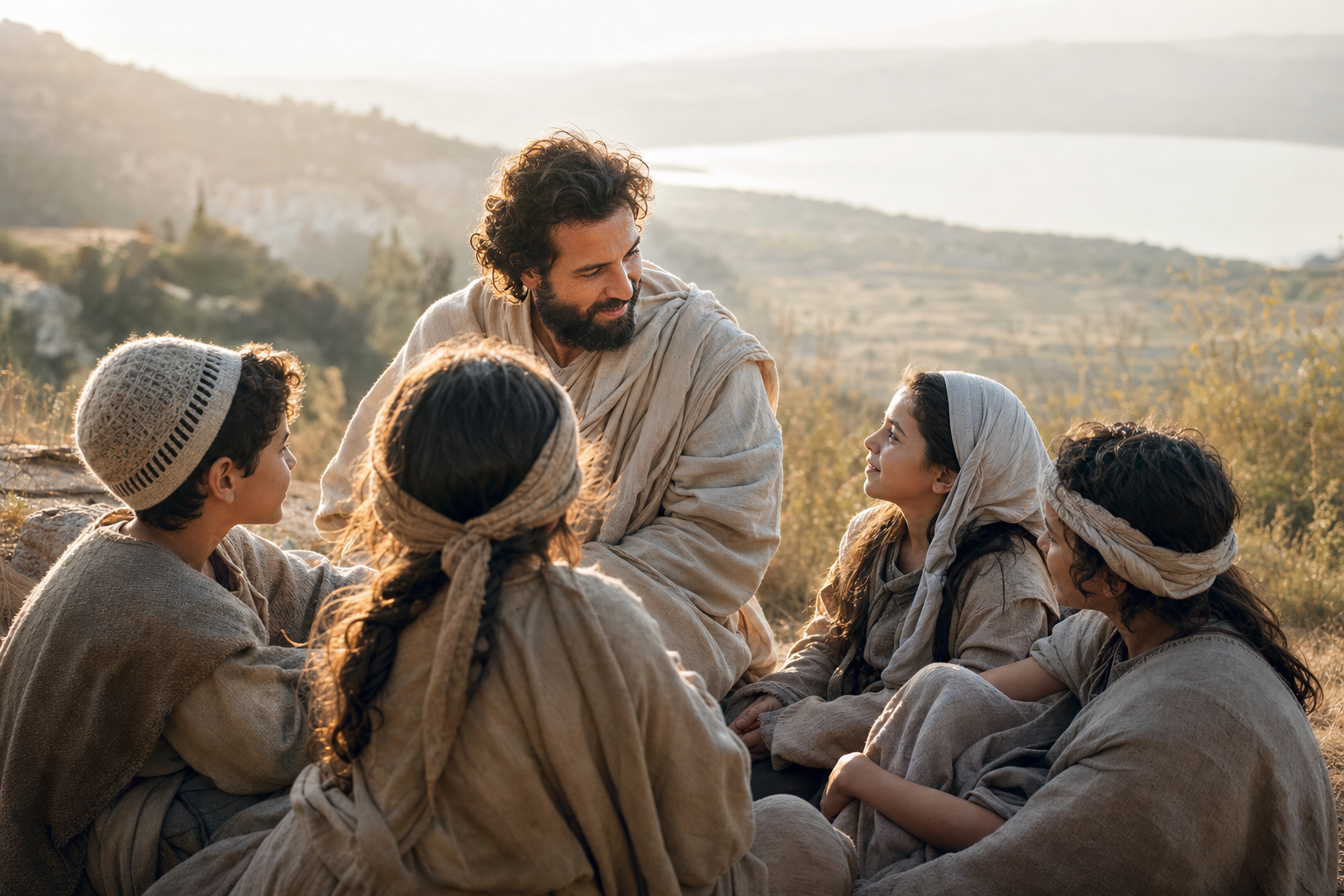
But what does Christ do with children who feel pushed to the edge? The gospel of Mark records a moment striking for its ordinariness (Mark 10:13–16). Children are brought—perhaps wriggling, perhaps shy—to where Jesus teaches. The disciples, believing they guard something holy, push the little ones away. They mutter, protect, create margins.
But Jesus is “indignant.” Not in mild irritation, but with deep, corrective passion, He interrupts the lesson. “Let the children come to Me; do not hinder them, for to such belongs the kingdom of God.” He gathers them, not as objects for a fleeting illustration, but as present core members of God’s new people. He lays hands, blesses—not because of their virtue or performance, but by His royal decree. In that moment, Jesus closes the gap: children, with all their real and unfinished stories, are welcomed to the very heart of God’s unfolding work.
This is more than moral encouragement. It is a public, kingdom-centered act. Jesus is not saying, “You might belong if you try hard enough.” He names children as already belonging—not by their merit, but by His identity as King and Life-Giver. Their stories, with all ordinariness and need, become a living part of the divine narrative. The invitation is not for the page’s edge, but the center.
Scripture Refuses to End the Story: Hebrews’ “Unfinished” Arc
If the Gospels display Jesus’ personal welcome, the rest of Scripture strengthens its permanence. The book of Hebrews tells of faith’s heroes—Abraham, Moses, Rahab, David—each assigned a place in God’s drama. But the ending is surprising: “All these, though commended through their faith, did not receive what was promised, since God had provided something better for us, that apart from us they should not be made perfect” (Hebrews 11:39–40).
The story is unfinished on purpose. Generations past are waiting—for whom? “For us.” The language is astonishing. Children and adults are not add-ons or belated fans. They complete the story being written by God. The saints of old lean forward, for in God’s design, their own script is fulfilled only when joined with ours. Every act of trust, kindness, or sacrifice—however small, whether done by ancient patriarchs or present children—threads into a still-forming tapestry, woven by Christ Himself.
Together in Christ: God’s Workmanship—Right Now
Paul’s words in Ephesians 2:10 seal this truth: “For we are His workmanship, created in Christ Jesus for good works, which God prepared beforehand, that we should walk in them.”
This isn’t adulthood-exclusive. In Christ, every person—including each child—is authored within God’s living drama. The “works” (moments of repentance, care for a friend, choice to listen, courage to speak up or to forgive) are not accidents or spiritual leftovers. They are prepared, named, and woven by God for us—right now. Small hands and ordinary days are not lesser in Christ’s sight; they are the essential venue of His creativity and purpose. Christ Himself writes present faithfulness into the epic, not as a minor subplot, but as the ongoing main story.
Closing the Distance: Living and Naming God’s Story Together
What now? How can adults and children move from lessons about ancient heroes to vibrant partnership in God’s current story?
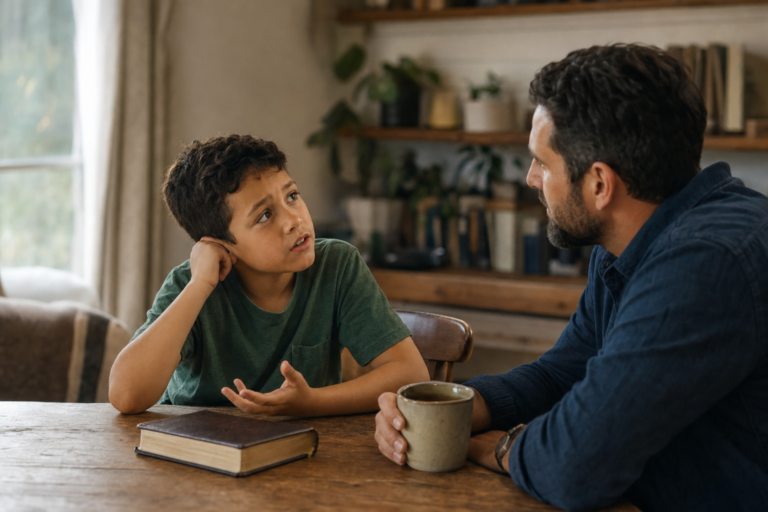
- Model “story location” in speech and practice. Instead of confining God’s work to history, adults can actively name the moments where Christ is at work today: “This was a God story moment, because Christ loves and includes you right now,” or, “Your apology to your brother is part of God’s story—you are His workmanship.”
- Interrupt hero-only storytelling. Share tales of both great courage and ordinary struggle. Let children see that staying faithful in discouraged times is as much God’s work as any conquest. Point out that in Scripture, saints often wavered, doubted, or waited—a space where children’s own stories fit and matter.
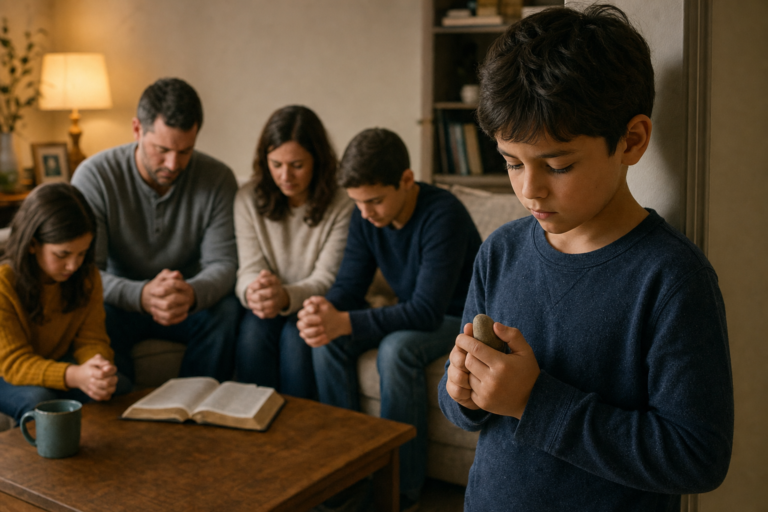
- Practice communal storytelling—at the table, in the car, before bed. Regularly pause to ask, “Where did you see Christ at work today?” or “How is God helping you become more like Him this week?” Not as spiritual performance, but as testimony of shared belonging. Frame even the smallest growth as evidence of God’s living story continuing in us.
- Replace evaluative comparison with Christ’s invitation. When a child says, “I’m not as strong as Samson,” or, “I can’t do what Ruth did,” shift the framework: “Jesus isn’t looking for another Samson or Ruth—He welcomes you into His story, just as you are now.”
The effect? The drift from “spectator” to “participant” doesn’t require theatrical miracles—just honest, biblical attention to Christ’s present invitation, and the courage to name it aloud in everyday life.
When a Child’s Place Is Named—A Living Picture
Picture, now, the craft table days later. Abraham and Ruth still stand, their faces gentle with the memory of hope and hunger. But the child’s new drawing is different: her paper figure stands among them, not in the background, but embraced in the center—her name written alongside theirs. This time, she wears a smile. She is part of the story, not because she forced her way in, but because Jesus called her daily life essential. Her apology, her kindness, her silent courage are no less a line in God’s epic. She draws it, lives it, and learns—sometimes quietly, sometimes stumbling—how Christ Himself writes each step.
This is the invitation: to leave behind the myth of spiritual spectatorship, and to anchor every child—and every adult—in the living, unfinished, Christ-rooted story that unfolds today. The line continues. The story lives. And in Christ, we are never on the margins.