How Christian Educators Guide Growth Through Failure

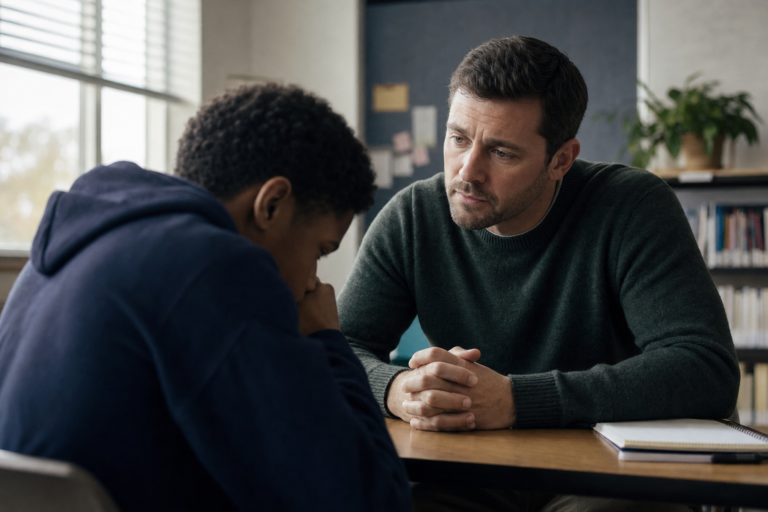
Consider a scene repeated in many classrooms: A student lingers after class, clutching a marked-up test, unable to meet the teacher’s eye. The classroom empties, but the moment hangs heavy. Beneath the red ink and lowered gaze, failure threatens not just a grade, but a sense of belonging and value. For many teachers—perhaps more than we readily acknowledge—memories of personal stumbles surface: an unkind word, an off-kilter lesson, the silent anxiety that one’s own inadequacy is exposed. Here, in the ordinary friction of a school day, Christian formation faces its greatest test—not in success, but in the valley where success slips away. When failure arrives, a question takes root: What will define us now?
When Failure Writes the Script
For many students—and many teachers—failure is not simply a disappointing event, but a verdict on their deepest identity. The everyday world of grades, classroom management, and teaching evaluations sends the message that only the strong, the quick, the always-on thrive. Performance, silently or loudly, becomes the marker of worth; mistakes become prophecies of future defeat. The Christian classroom, while marked by Bible verses and prayers, is not always immune. Spiritual language can even become one more mask to hide uncertainty or reinforce perfectionism: “God expects excellence, so don’t disappoint Him or us.”
Behind these tendencies is a formation gap: if the gospel truly proclaims that Christ’s grace defines us—not achievement or flaw—why do so many who confess Christ treat failure as a secret to be hidden, or a contamination to be swiftly sanitized? If every classroom setback is only a shadow to escape, the transformative power of Christ’s cross and resurrection remains distant, more theory than reality. The hidden drama is over whose story explains what went wrong—and what now becomes possible. It’s the contest between shame and the re-authoring hand of Christ.
Christ’s Restoration at the Point of Collapse
Consider Peter. If ever a disciple appeared beyond restoration, it was the one who denied Jesus loudly and publicly. In John 21:15–19, after the resurrection, Jesus stands on the shore and calls Peter into a conversation that heals by going straight to reality. Jesus asks, “Simon, son of John, do you love me?” Not once, but three times—echoing the bitter threefold denial just days earlier. With each question, Peter meets his failure face to face, yet finds not retribution but mercy. Every scar is re-touched, not to rub it in, but to show that grace knows the full wound. Jesus does not rewind the clock nor diminish the seriousness of Peter’s actions. Instead, He restores Peter to fellowship and entrusts him with new purpose: “Feed my sheep.” Restoration doesn’t erase the past, but turns it into a doorway to service when met by Christ.
This episode becomes a template for educators called to lead in Christ’s name. To echo the Lord in moments of classroom failure is not to merely shrug off mistakes or to offer hollow reassurance, but to hold space for honest naming and hopeful commissioning. Only a classroom rooted in the gospel can absorb real setbacks without collapsing into blame or denial. The Christian teacher operates not as an accuser, but as a restorer—refusing to bury the truths that need healing, and refusing to let the student’s story end in shame.
Embracing Weakness as Grounds for Growth
Where does strength in the Christian life truly come from? Paul’s unsettling answer in 2 Corinthians 12:9–10 is that “power is made perfect in weakness.” Paul is no stranger to relentless expectations, both internally and externally imposed. Yet he writes with conviction that only in the places where his capacity fails—where his efforts unravel—does the sufficiency of God’s grace become tangible.
Translating this to the classroom, Christian educators resist the cultural pressure to demonstrate flawless control or polished image. Instead, they model the kind of appropriate vulnerability that helps both teacher and student see weakness as a meeting place with God. A teacher admitting, “This lesson didn’t work how I planned, and I’m learning from it,” does not abdicate authority, but embodies a rare courage—one that matches gospel reality and invites students to see themselves not as defective, but as people in whom Christ delights to work.
This humility is not permission for laziness or carelessness with stewardship. Instead, it is a form of spiritual honesty that disarms perfectionism and makes space for God’s work amid our ordinary limitations. Educators permit—even if only with trembling hope—that the classroom can be a safe place to fall, repent, and rise.
Getting Up Again: The Scriptural Pattern
The wisdom of Proverbs 24:16 is painfully practical: “Though the righteous fall seven times, they rise again.” Embedded in this proverb is a subtle distinction: righteous people are not those who avoid falling, but those shaped by their willingness to rise by God’s help. The scriptural picture is remarkably honest about the inevitability of failure. Resilience is not self-invention; it is a form of courage that trusts the possibility of being raised.
Practically, this means Christian educators re-orient the conversation about failure toward identity in Christ, not as a denial of the facts, but as a refusal to let the last word belong to fear or shame. A restorative conversation might include both honest ownership and gentle questions: “What have you learned? Where have you seen Christ meet you here? What next step does hope suggest?” It’s a chance to help students see their failures as an invitation to wisdom, not exile from belonging.
Such practice has a ripple effect. When modeled across the classroom, it seeds a collective memory: We are not exiled by a single mistake. We rise—together—because God is not finished.
Discipline as Redemptive Formation
It is possible to be captured by grace and lose clarity about boundaries and consequences. Yet Hebrews 12:5–11 makes clear that God’s discipline is a hallmark of His love—a fatherly intent to train for “a harvest of righteousness and peace.” Christian discipline is neither a punitive act nor a sentimental avoidance of consequence. Instead, it is a means for guidance, maturity, and ultimately, peace.
For educators, this means that correction should be explained as part of a process, neither rushed nor administered coldly. When a student disrupts, cheats, or neglects their responsibilities, the educator responds with clarity, but never with a final pronouncement of worthlessness. The process includes questions that invite the student back into relationship as well as accountability: “How can you make this right? What will it look like for you to seek God’s help here?” The path moves through truth-telling, confession, and restorative steps, marking discipline as a channel for growth rather than exclusion.
Mechanisms: How Gospel Practices Change Classroom Culture
Redemptive Narrative Interventions
Classrooms are not neutral: they are story-shaped places. Teachers can shift the narrative around failure away from shame and toward gospel renewal through intentional ‘redemptive narration.’ After a failed group project or public mistake, rather than letting the silence fester or simply moving on, the teacher convenes students for reflection. Together, they name what broke down, but just as importantly, highlight where honesty, persistence, or humility began to emerge. The moment ends not with a eulogy for lost points, but with a prayer or reminder: “God’s story is not stopped by this setback; what might He be teaching us?” Over time, these interventions re-train the community to see stumbles as the context for grace, not disqualification.
Vulnerability Modeling
Educators indirectly communicate the gospel by how they handle their own limitations. When a teacher narrates their process (“I prepared carefully, but this still didn’t connect today; I’ll keep learning, too”), it grants students permission to be honest about their learning curve. Paul’s “boasting in weakness” was not a call for self-deprecation; it was an act of faith in God’s promise to act through human limits. In classroom practice, teachers might set aside time to share select, appropriate stories of personal learning, showing that growth is ongoing, and mistakes do not negate value. The aim is not to dissolve boundaries or shift responsibility, but to make visible the very hope we want students to trust: that the Lord meets every one of us at our weakest and supplies what we cannot manufacture.
Restorative Process Feedback
Correction in gospel-shaped classrooms moves beyond “what went wrong” to “where does restoration begin?” After a failed quiz or behavioral breakdown, the teacher may first address the facts honestly, but then links feedback to specific next steps and encouragement rooted in identity: “Yes, this was a tough moment, but I see courage in how you’re responding. Here is what you can focus on next, and remember, your worth is not on trial—Christ has already given you a name.” Consistently applied, this practice helps students anticipate possibility rather than recoil in shame, cultivating a culture of hope-driven perseverance.
Case Vignettes: Formation in the Ordinary
What does this look like in everyday practice? The following composite scenarios, assembled from recurring patterns educators encounter, illustrate how these redemptive approaches might unfold in real classrooms. These are not accounts of specific individuals, but representative of actual challenges and gospel-rooted responses.
Vignette 1: The Math Test
Imagine a seventh grader—an habitual overachiever—who fails her first major exam and responds with tears. Her teacher observes her lingering after class, clearly dreading the look in adult eyes that usually signal disappointment. Instead, the teacher gently initiates a conversation, perhaps saying, “When we fall short, it hurts. But your worth isn’t set by this grade. What do you believe Christ sees right now?” The two discuss Peter’s journey, not just as a Bible lesson, but as the backdrop for the student’s own life. They pray—not for easy answers, but for the kind of wisdom and perseverance Peter discovers after failing and being restored. The student must still address academic gaps, but the fear of rejection recedes; growth is no longer synonymous with perfection.
Vignette 2: Discipline Restored
Consider a student who repeatedly interrupts class, receives a consequence, and responds by withdrawing in frustration. The teacher, instead of simply enforcing rules or ignoring him, takes time after class for a restorative process. Drawing from Hebrews 12, the teacher explains that consequences are not meant to push him out, but to help him grow strong. She listens to his frustration, invites him to consider what it would look like to make things right, and prays with him for renewed self-control and a new start. Such conversations are rarely quick or easy, but over time, the student comes to understand that discipline is not a threat to his dignity, but an affirmation of his belonging and potential under Christ’s care. The dialogue here is paraphrased to reflect the nature of restorative conversations, not quoted from an actual exchange.
Name the Objection: Is This Naive or Irrelevant?
An honest skeptic may ask: Doesn’t this Christ-centered approach risk making students unprepared for the real world’s standards? Isn’t it naive to center a formation journey on hope when life deals in consequences?
It is precisely here that gospel-rooted education stands apart. To be clear, grace does not erase all consequences. Christ restored Peter, but Peter still bore scars—and responsibilities. Restorative feedback in the classroom never avoids the facts. Instead, it insists that the deepest outcome of failure is not rejection, but renewed calling. Only the cross can take the full weight of our stumbles and set them in a story where love—not performance—has the last word. Rather than sidestepping rigor, this approach dignifies students with the challenge and safety to face reality, grow through confession and perseverance, and prepare with resilience that outlasts any single failure or success. Grace does not immunize students from the world but equips them to face it—rooted in Christ, not merely by personal achievement or the avoidance of defeat.
Sowing Lasting Roots: Transformation Beyond the Classroom
Classrooms that rely wholly on performance can produce temporary results, but classrooms marked by Christ’s restoration shape something far deeper: habits of resilience, confession, forgiveness, and hope that will outlast letter grades and test results. As educators embed practices of redemptive narration, vulnerable honesty, and restorative feedback, they sow seeds that will take root across entire lives. Students shaped by these rhythms begin sharing the same kind of grace and perseverance with their peers, families, and future communities—becoming agents of gospel resilience wherever life tests character.
No classroom, no educator, embodies this perfectly. But with every ordinary moment of failure—at any desk, on either side of the classroom—there is a crossroads: return to old stories of shame and performance, or sink deeper roots into Christ. The lasting impact is not merely an improved GPA, but students and educators awakening to the reality that every failure is a place where Christ’s resurrection can take hold. The formation that begins here stretches outward: multiplying hearts that rise again, and again, because the final word belongs not to defeat, but to Him who restores and calls us on.