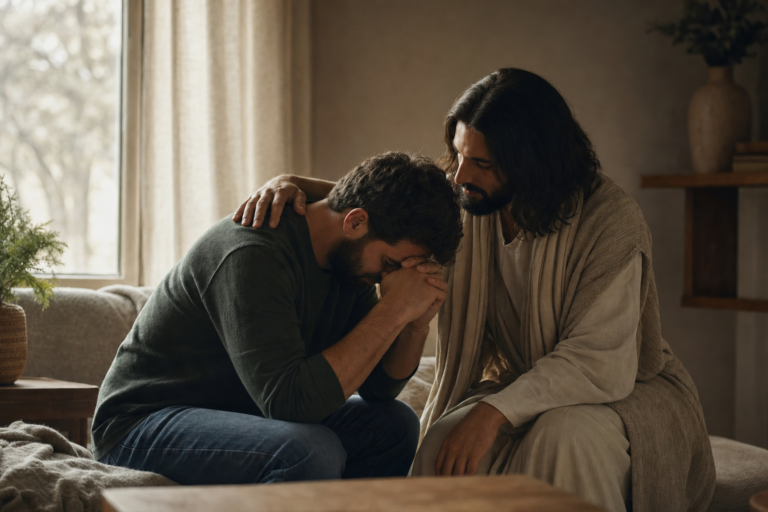
How Christ Meets Us Amid Spiritual Exhaustion

The lamp’s pale circle barely reaches beyond undone lists and prayer requests scribbled on slips that now blend with weary silence. It’s late, but the world of ministry and care has not fallen quiet—only your body has. Hands folded almost by habit, you search for words. Yet exhaustion crowds out language, and the hush feels deep—has fatigue carried you outside God’s welcome? Beneath the surface: a question hard to name—will Jesus draw near to me here, or have I strayed too far?
The Hidden Weight of Faithful Fatigue
For many followers of Jesus, weariness is not a badge of laziness or lack of devotion, but the result of giving more than we know how to refill. We carry burdens—relational needs, losses, unanswered prayers, and the demands that come with faithful love. Even well-worn spiritual routines sometimes provide little relief; the tiredness lingers deeper, settling not in the body alone but in the spirit.
Yet admitting this is rare. In Christian spaces, energy and cheerful perseverance are prized. When we run out, we may wonder, “Is my faith deficient? Am I weaker than everyone else?” The temptation is to mask depletion or to double efforts, all while believing real Christians shouldn’t be this tired. Over time, shame-filled silence grows thick. Is rest truly for people worn down by good work, or just for those who remain unaffected?
But Scripture does not cast out the weary. The invitation of Christ begins exactly where our strength ends.
Christ’s Invitation: Rest for the Spent
Jesus does not meet exhaustion with critique. In Matthew 11:28–30, His invitation is pointed and personal:
“Come to me, all who labor and are heavy laden, and I will give you rest… Take my yoke upon you, and learn from me, for I am gentle and lowly in heart, and you will find rest for your souls.”
Notice that Christ’s call is not to escape work or responsibility, but to a shared life. The ‘yoke’ He speaks of is an image of close union—the tool that binds two together in step. In the ancient world, a stronger animal bore more weight in the yoke so the other would not be overwhelmed. The burdened come, and Jesus offers Himself, not as an advisor, but as a steadying presence beside them. His presence is the rest.
This yoke isn’t another task or spiritual hoop; it’s a place to discover humility, gentleness, and a new rhythm. Jesus promises, “My yoke is easy, and my burden is light.” Why? Because He shoulders fatigue with us. To accept Jesus’s invitation is not to forego faithfulness, but to shift from self-reliance to dependence—no longer endlessly giving, but learning to receive as necessity, not bonus. This is rest: meeting God in weakness, not after recovering strength.
The Courage to Lament: Moving Toward God in Exhaustion
What does it look like to respond to this invitation when you feel emptied? The next step is honesty. Scripture models this in Psalm 42:9–11:
“I say to God, my rock: ‘Why have you forgotten me?… Why, my soul, are you downcast? Put your hope in God, for I will yet praise him, my Savior and my God.’”
Lament is not faithlessness but faith dared aloud. The psalmist does not polish his feelings before approaching God. Instead, he brings his tired questions, his discouragement, even the feeling of abandonment—right into the relationship. Naming exhaustion is not spiritual failure. It is a holy act; it breaks the cycle of silent suffering and brings our honest need to God’s notice. Lament transforms private endurance into dialogue, opening the heart to grace rather than shame.
This practice isn’t only for ancient poets. In the company of trusted friends, in a journaling prayer, or as a small group discipline, naming what is truly there—weariness, disappointment, ambivalence—becomes fertile ground for hope. Faithfulness is not measured by persistent cheer, but by persistent truth-telling before God. Lament is a doorway to renewal because it keeps us moving toward Christ, even when the journey stutters.
Biblical Rest: Deeper Than Doing Less
When exhaustion persists, familiar solutions urge us to withdraw or simply “try harder.” But biblical rest is not found by toggling between these extremes. Hebrews 4:9–11 roots true rest in trust, not inactivity. The passage references Israel’s wilderness wandering, where God’s people missed His rest—not for lack of effort, but for a resistant heart that would not depend on God’s provision. The letter reminds: “There remains, then, a Sabbath rest for the people of God… Let us, therefore, make every effort to enter that rest, so that no one will perish by following their example of disobedience.”
This is not simply an abstract Sabbath, nor is it only the literal seventh-day Sabbath established at Creation and enjoined in the Ten Commandments (Exodus 20:8–11), which remains a weekly gift. Rather, Hebrews points us to an ultimate rest fulfilled in Christ—a continual posture of surrender and confidence in His accomplished work. For the weary, this means rest is available not because burdens disappear, but because the labor of proving ourselves is over. We are invited again and again into Christ’s completed provision, learning to cease striving for spiritual security and instead to depend on Him in our limits and exhaustion.
Biblical rest calls us to trust God’s heart more than our own capacity, to stop striving at the point where control would replace surrender. Sabbath as a day is a boundary for ceasing; Sabbath as a way of being is a new foundation for all our doing. Both are gifts—never earned, always received.
Strength in Weakness: Paul’s Surprising Boast
If anyone could have claimed spiritual invulnerability, it was Paul. Yet in 2 Corinthians 12:9–10, he writes candidly of repeated, unanswered prayers for relief. Instead of removing the burden, God answers:
“My grace is sufficient for you, for my power is made perfect in weakness.” So, Paul concludes, “I will boast all the more gladly about my weaknesses, so that Christ’s power may rest on me… For when I am weak, then I am strong.”
This passage reframes exhaustion not as a flaw but as a site of revelation. Weakness becomes the doorway through which Christ’s sustaining presence is experienced most deeply—not always as newfound energy, but as endurance and hope that arises outside of self. Paul does not romanticize his struggles, nor does he disconnect them from his mission. Instead, he lives within them, letting his admissions of need become the context for God’s sufficiency to show up.
The implication is clear: true spiritual resilience is not a product of unbroken strength, but of continual exchange—my emptiness for the fullness of Christ. Every encounter with weakness is a fresh invitation to lean in rather than withdraw, to invite Christ’s life to be seen precisely where my own is running out.
From Relentless Doing to Shared Abiding
If you listen closely, the biblical witness answers the skeptical question: “If Jesus gives real rest, why do the most devoted sometimes seem the most depleted?” The answer is not that maturity makes us invulnerable, but that it teaches us not to hide our need. Christ’s call is not away from community and responsibility, but toward a different rhythm—one infused with shared honesty, vulnerable trust, and dependence rather than constant striving.
How do we enter such a rhythm?
- Lament as Devotion: Designate regular moments—a late evening, the commute, a pause after work—to name what is depleted. Write or pray aloud, letting fatigue, disappointment, and even anger become part of your spiritual vocabulary. Do this as an act of faith, trusting Christ receives you as you are, not as you wish to be.
- Slow Engagement with Christ’s Invitation: Each day, linger over Matthew 11:28–30. Read it slowly, one phrase at a time, and breathe. Let its words linger. Resist the urge to fix yourself first; listen instead for how Christ gently welcomes your weakness without rebuke. This is not another to-do, but space to receive.
- Burden Sharing in Community: Suggest to your group or family a routine space—a weeknight, a Sabbath afternoon—for speaking openly of fatigue and praying simply for each other’s strength. Offer help with specific needs where possible (a meal, childcare, running errands), for in these practical actions, Christ’s yoke is made tangible. Encourage a culture where rest is granted, not earned, and weakness is met with companionship, not pity.
These rhythms foster an environment where exhaustion is not something shameful to hide, but becomes part of the fabric of honest, Christ-centered life together. Over time, they weaken the grip of silent overwork and anchor resilience in the gift of abiding.
Exhaustion as Sacred Space: Receiving Christ’s Presence
When weariness is no longer a dirty secret, it becomes a place where Christ draws near in unmistakable ways. In the unfinished, in faltering prayers and the silence that follows, He does not look for productivity but for presence. The body of Christ grows strong not by the stamina of individuals, but by the shared discovery that Christ’s sufficiency flourishes where no one pretends to have it all together.
Communities rooted in these truths model rest as hospitality—making room for one another’s limits, honoring vulnerability, and practicing tangible help. Within such a fellowship, exhaustion loses its sting; instead, it becomes the ground where Christ’s sustaining life is multiplied and received.
Still Before Christ: An Ending, a Beginning
Imagine, now, at the edge of another day, simply sitting before Jesus. Your hands are open, your heart is tired, and your words may be few. You’ve named your fatigue—He receives it fully. There’s no demand for impressive resolve or spiritual performance. Instead, there is gentle companionship—His nearness is the rest.
Prayer: Gentle Lord, in my emptiness I come. Let my weariness become the soil for your sustaining life. Shape in me habits of honest lament, deeper trust, and rhythms of abiding that depend on you when I have nothing left to give. Help me to welcome the tiredness of others, turning community into sacred ground for your love. Amen.
May your life and your community be marked by this kind of rest—a fellowship where exhaustion is not erased, but met, held, and gently restored in the presence of Christ. His rest is available here, precisely where you are, whenever your strength runs out.