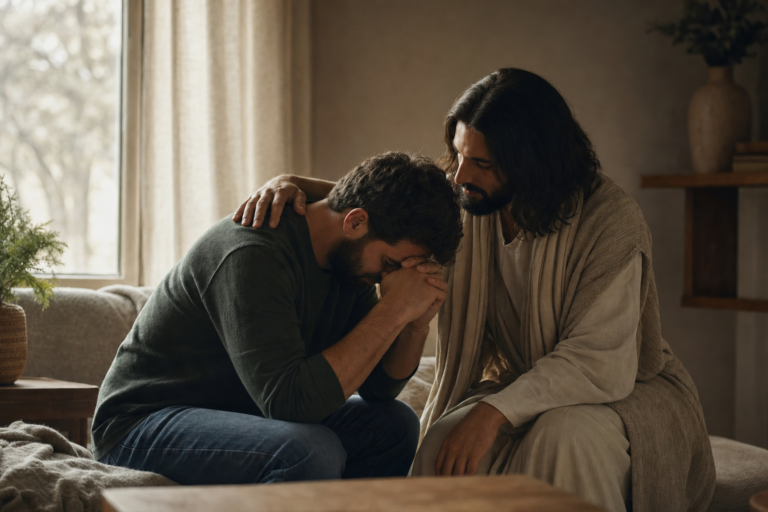
How Christ Changes What Failure Means for His Disciples

The late-night desk lamp casts long shadows as a leader flips through a well-worn Bible, praying for the hundredth time that “this time” will be different. He’s walked with Jesus for years. Preached grace. Led small groups. But a private cycle—old sin, new resolve, collapse, shame—clings like heavy clothing. The prayers seem sincere, the resolve real, and yet the collapse arrives—again. What if the congregation knew? What if Jesus is disappointed, weary, or ready to move on? Most days, he carries on. Sundays are steady. But inside, the silence deepens—a quiet dread that maybe he’s not just weak, but a fraud.
This dilemma is far more common than Sunday smiles suggest. Many Christians—teachers, elders, parents, long-time attenders—live with a web of unfinished change. The persistent distance between who we long to be in Christ and who we keep reverting to becomes heavier over time. Outward faithfulness can mask a weary isolation: “Why do I keep failing here? Is something wrong with me that’s beyond help?” Church can become a place for polished reputation, but the deeper story—the unresolved patterns, the vows to change, the resignations—goes mostly unspoken, except perhaps to God in restless prayers.
The Hidden Cost of Discipleship Failure
If you’ve ever wondered why persistent patterns seem unbreakable, or why hope fades after repeated collapse, you are not alone. Most devout Christians—even leaders—know this cycle: seasons of boldness followed by unexpected defeat. The aftermath is more than a matter of the specific sin or weakness. The deeper wound is the suspicion that grace has limits—that we have finally outrun God’s patience. What’s left is shame, which breeds isolation. Discipleship can start to feel like an audition for a distant critic, rather than a relationship fueled by compassion and mercy. Many begin performing, withdrawing, or oscillating between self-condemnation and desperate effort. Self-disqualification takes root quietly, years before anyone else could offer correction—often when everyone else would offer support if only the secret was told.
When Christ Sees Collapse Coming: Peter’s Story Before the Fall
Scripture refuses to shrink or sanitize discipleship failure. Peter, Jesus’ outspoken disciple, walks through this fire in full view. On the night before Jesus’ crucifixion, Peter is certain of his commitment: “Lord, I am ready to go with you to prison and to death!” (Luke 22:33). Jesus sees through the bravado, revealing a battle much deeper than willpower or intent: “Simon, Simon, behold, Satan demanded to have you, that he might sift you like wheat, but I have prayed for you that your faith may not fail. And when you have turned again, strengthen your brothers.” (Luke 22:31–32)
Christ’s response is utterly unlike our instinct. He does not shame or warn Peter away. He does not predict failure to humiliate him. Instead, Jesus names the real battle, assures Peter of His ongoing advocacy, and reframes his future as one of restoration and ministry. Christ is not scandalized or surprised by Peter’s coming collapse. His vision looks past the coming denial to a future where Peter, out of restored fellowship, “strengthens his brothers.” The hope of the disciple does not rest on self-protection or private resolve, but on Christ’s intercession—His ongoing prayer and provision even before the failure comes. This is redemptive groundwork laid in advance.
Collapse, Shame, and the Search for Restoration
Despite the warning, Peter bravely steps forward—only to stumble. The story unfolds painfully: Peter, caught in a swirl of fear and confusion, denies even knowing Jesus three times (Luke 22:54–62). The rooster crows, as predicted. Peter remembers Jesus’ words and breaks completely, slipping out into the darkness to weep with bitter grief. Here, disciples across the centuries find themselves: the moment of collapse, when strong intentions are shattered by the force of circumstances or unseen motives, and the only apparent outcome is shame. The ancient echo meets today’s sigh—“is this the point where Christ leaves me behind?”
Most people respond by hiding, quitting, or making quiet bargains to try harder next time. Peter drifts back to his former occupation—fishing—carrying a silent ache that his story with Jesus is now over (John 21:3). He neither presumes on restoration nor demands it. The ache of unfinished change, the shame of public weakness, and the longing for some way back are realities as relevant now as then.
Christ’s Pursuit—and Redefinition—of Failure
The gospel’s answer does not come as a formula or anonymous assurance. Jesus, now risen, deliberately seeks Peter out. John’s gospel narrates their encounter at dawn, beside a charcoal fire, with the other disciples present. Jesus asks three times: “Simon, son of John, do you love me?” (John 21:15–17). Each question acknowledges Peter’s three denials—drawing them into the open, not to wound, but to heal. The conversation is painful in its precision, but also redemptive: Jesus treats failure not as a closed case, but as a place of honest encounter and recommissioning.
Peter affirms his love—hesitantly, perhaps, with humbled honesty rather than boastful certainty. With each affirmation, Jesus charges him: “Feed my sheep.” The restoration is deliberate, public, and deeply personal. Jesus does not flatten grace into mere forgiveness or erase memory of the sin. Peter is not sent back into ministry as he was before; he stands now as one who knows defeat, has tasted Christ’s restorative patience, and must depend on the mercy he proclaims to others. The site of his worst collapse becomes the ground for his most profound calling. Jesus reframes failure—not as the final word, nor as a mere learning moment, but as the context in which grace, humility, and lasting influence are forged.
Paul’s Weakness and Christ’s Restorative Economy
The pattern extends beyond Peter. Paul, another foundational figure, bears his own persistent weakness—a “thorn in the flesh” pleaded over in prayer (2 Corinthians 12:7–10). Unlike Peter’s dramatic moment, Paul’s struggle is chronic, defeating, seemingly unchangeable. Christ’s response is not to remove the struggle but to reinterpret it: “My grace is sufficient for you, for my power is made perfect in weakness.” Paul’s conclusion is not resignation, but a radical embrace of the economics of grace: “Therefore I will boast all the more gladly of my weaknesses, so that the power of Christ may rest upon me.”
In both Peter and Paul, the cardinal mark of Christ’s disciple is not the absence of failure, but the lived experience of Christ’s sufficiency precisely in the site of collapse. Dependence on Jesus—made vivid and operational in failure—becomes the new economy for growth. This is not passive acceptance; it is active engagement with the truth of our need and Christ’s nearness. It is a resilient hope, forged in weakness, that does not give way to hiding or mechanical striving. Paul will continue to labor, suffer, and serve—but not as an apostle of personal performance. His story witnesses that union with Christ is tested, refined, and displayed most clearly in seasons of inability, not just victory.
How Christ Reframes Failure for His Disciples: Three Shifts
1. Honest, Christ-Centered Confession—Not Self-Absorption
The movement away from shame and despair begins with direct confession, not melodrama or self-justification. Peter’s exchange with Jesus resists both superficial apology and ceremonial repentance. Jesus does not let him deflect or collapse into generalities; He asks pointedly, and invites a response in real relationship. For us, honest confession before Christ means naming where we have lost heart, fallen short, or stayed silent—not in hope of managing our reputation, but in trust that Christ desires to meet us where we are, not just where we ought to be. This is an act of faith in Jesus’ character and patience—believing He is more invested in restoration than we are.
2. Restoration Within Community—Not Private Self-Repair
One distinct feature of Peter’s restoration is its public setting. Jesus does not reinstate Peter alone, but before others, establishing a model in which restoration is communal and scripturally anchored. Discipleship is not a solo sport. While confession may begin privately, recovery finds its footing when brought into the light with trusted people of God. In healthy community, honest weakness becomes a resource for shared growth and accountability—not a tool for shame. This step disrupts the default strategies of secret struggle or shallow “safe” confession, and it opens space for witnessing the truth of Christ’s grace as it works in visible lives. It creates new family culture—one shaped not by the myth of unbroken victories but the living memory of restoration and repentance walked together.
3. Letting Christ’s Word, Not Self-Verdict, Carry Authority
Ultimately, Peter is not defined by his failure, nor by self-contempt. Paul refuses to become a spiritual fatalist. In both cases, the decisive factor is Christ’s spoken word: “When you have turned again, strengthen your brothers.” “My grace is sufficient for you.” The shift, practically, is to let what Jesus says about us have greater weight than what inner verdicts declare. It is not mindless repetition, but chosen realignment. The gospel is not simply the announcement that we can try again; it is the reality that Jesus, who knows our whole story, invites us to stand, receive, and participate in His ongoing work. This posture demands we regularly recognize when inner monologues or comparative judgments are drowning out Christ’s living word. Spiritual growth becomes a matter of practiced attention—not just moral muscle, but anchored listening.
An Objection: Isn’t Grace Just Permission to Stay Stuck?
A persistent concern shadows any robust grace: Doesn’t all this restoration and recurring mercy invite laziness or excuse? If Jesus always forgives, why change?
Scripture cuts through such distortion. Peter is not restored to comfort, but to costly love—one that eventually costs him his life (John 21:18–19). Jesus’ grace is not sentimental leniency but restorative fire. Real repentance deepens—not because we must prove ourselves, but because encountering Christ moves us from shallow regrets to abiding dependence. Grace enables us to face the truth, risk transparency, and venture obedience again. Paul’s dependence did not yield passivity; it produced tenacious service, creativity, and resilience built on Christ’s sufficiency, not fear of being disqualified. The summons remains: grace does not excuse staying stuck, nor does it collapse under honest returning. Restoration in Christ is ongoing—forming real change, but always rooted in a deeper trust rather than a perfect record.
From Information to Embodied Transformation
If the argument stopped with Peter or Paul, it would remain inspiring but abstract. But Scripture insists that their experience with Jesus is meant as a practical model. The reframing of failure can become a way of life for today’s disciples:
- We bring specific defeats to Jesus, sometimes daily, without waiting until we feel worthy. Real, reflective prayer replaces ritual or performance.
- We seek out a handful of trusted fellow believers with whom we tell the truth and receive gentle restoration—embracing community as a channel for Christ’s healing, not merely self-management.
- We intentionally practice letting Christ’s words, as anchored in Scripture, be the lens through which we interpret our identity and calling, catching ourselves when self-condemnation or pride attempts to overrule grace.
As these practices deepen, a new kind of security emerges: humility that endures scrutiny, hope that persists through fresh collapse, and an honest witness to the world that finds strength—again and again—not in our spiritual disciplines, but in the presence and sufficiency of Christ. Communities slowly shift: believers become less interested in appearances, more available to the hurting, quicker to share stories of defeat and restoration. The soil of revival grows richer as honesty and repentance become celebrated, not feared or marginalized.
Letting Christ Redefine Failure and Write Your Story
What if the most persistent point of your defeat is the very place Christ is longing to meet you—not as a bystander, but as a patient Redeemer? The stories of Peter and Paul are not meant to be admired from afar but entered as living possibilities for every follower of Jesus. Their pathways—collapse, confrontation, restoration, and recommission—outline a reliable geography for discipleship in real life. You are not uniquely broken, nor has your story ended in the silence of your last failure.
The measure of true discipleship is not how few mistakes we hide, but how quickly we return to Christ and how honestly we permit Him to reshape our story. His verdict matters most. The invitation stands: bring your rupture, your regret, your habit, your recurring collapse—before Him. Do not live in self-imposed exile. Restoration is possible and, in Christ, defeat can become the ground not of permanent exclusion, but of deeper dependence and hard-won hope. Move toward the light, risk sharing your need with trusted brothers or sisters, and let your weakness become a living witness to the One who seeks, restores, and sends.