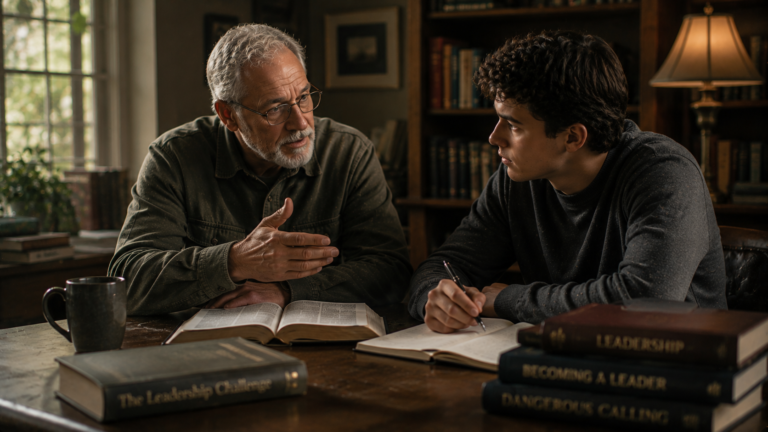
Why Do Some Leaders Finish Well and Others Do Not?

Introduction
Many leaders begin well.
They begin with conviction.
Energy.
Vision.
Prayer.
A desire to serve.
Perhaps they never planned to become leaders at all. Responsibility simply grew around them. Someone trusted them. A ministry needed direction. A team needed guidance. A family needed stability. An organization needed someone willing to carry responsibility.
At the beginning, leadership can feel clear.
The mission matters.
People matter.
God’s calling matters.
But years later, the story may look very different.
Some leaders become wiser.
Humility deepens.
Character strengthens.
Their influence becomes less about themselves and more about the people they are preparing to serve after them.
Others slowly drift.
Power changes them.
Recognition becomes addictive.
Private compromises multiply.
Relationships deteriorate.
Accountability disappears.
The mission that once mattered becomes secondary to protecting position.
Some do not collapse publicly. They simply become spiritually empty while continuing to function successfully.
And some finish their assignment with the same fundamental faithfulness with which they began.
Why?
Why do some leaders finish well while others do not?
Scripture gives a sobering warning:
“Wherefore let him that thinketh he standeth take heed lest he fall.”
— 1 Corinthians 10:12, KJV
No leader becomes spiritually safe because they have led faithfully for a long time.
Past faithfulness does not make future faithfulness automatic.
Leadership must be stewarded until the end.
And perhaps that is the first truth every leader needs to remember:
Finishing well is not one final heroic decision. It is the accumulated result of thousands of smaller decisions made while no one yet knows how the story will end.
Starting Well and Finishing Well Are Different Achievements
Beginnings often contain momentum.
A new responsibility brings energy.
There is something to build.
Something to change.
Something to prove.
People are watching.
Expectations are high.
But finishing well requires something beginnings cannot test.
Endurance.
What happens after recognition becomes normal?
After disappointment?
After conflict?
After success?
After criticism?
After years of carrying other people’s problems?
After the leader discovers that not everyone appreciates sacrifice?
After the original excitement fades?
Scripture repeatedly honors endurance.
Paul could say near the end of his life:
“I have fought a good fight, I have finished my course, I have kept the faith.”
— 2 Timothy 4:7, KJV
Notice that Paul did not merely celebrate what he had begun.
He had finished.
That word matters.
Leadership is not ultimately evaluated only by the strength of the launch.
A brilliant beginning cannot compensate for the abandonment of faithfulness later.
Leadership Magnifies What Is Already Within
Leadership gives people greater opportunity to influence others.
It also gives what is already inside the leader more room to express itself.
Humility can become service.
Wisdom can become protection.
Courage can strengthen a community.
But insecurity can become control.
Pride can become domination.
Fear can become manipulation.
Ambition can become self-promotion.
The position does not necessarily create these things.
Often it exposes and amplifies them.
Jesus said:
“A good man out of the good treasure of the heart bringeth forth good things…”
— Matthew 12:35, KJV
Leadership flows outward from the inner life.
This is why leadership development that focuses primarily on techniques can become dangerous.
Strategy matters.
Communication matters.
Planning matters.
Organizational skill matters.
But a leader with excellent technique and weak character may simply become more effective at expressing unhealthy motives.
The greatest leadership threat is not always lack of skill. Sometimes it is an unformed heart carrying increasing influence.
Saul Shows How Leadership Can Expose the Heart
King Saul’s story begins with promise.
He appeared humble.
When Samuel first spoke of the honor that would come to him, Saul responded:
“Am not I a Benjamite, of the smallest of the tribes of Israel?”
— 1 Samuel 9:21, KJV
Later, when Saul was publicly chosen as king, he was found hiding among the equipment.
There was no obvious appearance of arrogant ambition.
Yet over time something changed.
Or perhaps something previously hidden became increasingly visible.
Saul began fearing people’s opinions.
When he disobeyed God’s instruction concerning Amalek, he eventually admitted:
“I have sinned: for I have transgressed the commandment of the Lord… because I feared the people, and obeyed their voice.”
— 1 Samuel 15:24, KJV
Saul’s leadership became increasingly controlled by image.
Position.
Comparison.
Fear.
When David received public praise, Saul could no longer simply celebrate what God was doing through another person.
David became a threat.
And once another person’s success becomes a threat to our identity, leadership has already entered dangerous territory.
Leaders Often Fall Slowly Before They Fall Publicly
Leadership collapse can appear sudden.
A scandal becomes public.
A resignation happens.
Trust disappears.
People ask:
“How could this happen?”
But public failure may be the final visible stage of a much longer private process.
Small compromises.
Unchallenged pride.
Isolation.
Hidden resentment.
Secret habits.
Ignored warnings.
Increasing defensiveness.
Spiritual neglect.
The leader may still preach.
Teach.
Manage.
Plan.
Produce.
The outward role continues while the inner life deteriorates.
David’s sin with Bathsheba did not begin with murder.
The progression moved through desire, misuse of position, adultery, deception, and eventually the orchestration of Uriah’s death.
James describes the progression of temptation:
“Then when lust hath conceived, it bringeth forth sin: and sin, when it is finished, bringeth forth death.”
— James 1:15, KJV
What eventually becomes visible often began much smaller.
This is why wise leaders do not ask only:
“Am I doing something catastrophic?”
They also ask:
“What am I allowing to grow within me?”
Success Can Be More Dangerous Than Failure
Leaders often fear failure.
But success carries its own spiritual dangers.
Success brings affirmation.
Access.
Influence.
Resources.
Recognition.
People begin asking for the leader’s opinion.
Others may stop challenging them.
The leader begins seeing evidence everywhere that their judgment is correct.
Eventually, success can produce the illusion of independence.
Moses warned Israel about precisely this danger:
“Then thine heart be lifted up, and thou forget the Lord thy God…”
— Deuteronomy 8:14, KJV
The warning came not when Israel was suffering.
It concerned the time when they would have houses, food, livestock, wealth, and abundance.
Prosperity could produce forgetfulness.
Leadership can do the same.
A leader may begin in prayer because dependence is obvious.
Later, experience grows.
Systems work.
People respond.
The leader knows what to do.
And prayer quietly becomes less necessary.
That is dangerous.
Success becomes spiritually dangerous when the fruit of God’s grace begins convincing us that we no longer need the God who gave it.
Leaders Who Finish Well Remain Teachable
One of the clearest signs of leadership danger is increasing inability to receive correction.
Early in leadership, a person may eagerly seek advice.
Later, experience grows.
So does authority.
Eventually feedback becomes irritating.
Questions feel disrespectful.
Disagreement feels disloyal.
Correction feels like attack.
But Scripture says:
“The way of a fool is right in his own eyes: but he that hearkeneth unto counsel is wise.”
— Proverbs 12:15, KJV
Wise leaders keep listening.
This does not mean following every opinion.
Leadership sometimes requires making decisions others dislike.
But there is a profound difference between discernment and defensiveness.
A teachable leader can say:
“I may have missed something.”
“Tell me what you see.”
“I need to think about that.”
“I was wrong.”
Those sentences become harder as influence grows.
That is precisely why they matter.
Finishing Well Requires Accountability
Isolation is dangerous for leaders.
Leadership can create unusual relational dynamics.
People may admire the leader.
Depend upon the leader.
Fear disappointing the leader.
Want access to the leader.
Need something from the leader.
All of this can make truly honest relationships harder to find.
A leader can be surrounded by people and remain deeply unaccountable.
David had enough authority to arrange Uriah’s death.
Nathan had enough courage to confront David.
He told him:
“Thou art the man.”
— 2 Samuel 12:7, KJV
Every leader needs people who can still say some version of that sentence.
Not enemies looking for failure.
Not people trying to undermine authority.
But trustworthy people who love God, truth, the mission, and the leader enough to speak honestly.
Ask yourself:
Who can question me?
Who knows my weaknesses?
Who can tell me I am wrong without fearing relational punishment?
Who knows something about my private spiritual condition, not merely my public performance?
If the answer is no one, leadership has become unnecessarily dangerous.
Leaders Who Finish Well Protect Their Private Life With God
Public ministry can create a strange spiritual illusion.
A leader can speak about God regularly without spending much private time with God.
Teach Scripture without allowing Scripture to search them.
Pray publicly while private prayer becomes thin.
Serve God’s people while personal communion with God weakens.
Jesus modeled something different.
Despite extraordinary demands:
“And he withdrew himself into the wilderness, and prayed.”
— Luke 5:16, KJV
His public ministry did not replace private communion with the Father.
For Christian leaders, this distinction is critical.
Preparing a sermon is not the same as being personally fed by Scripture.
Leading worship is not the same as worshiping.
Praying over a meeting is not necessarily the same as privately seeking God.
Religious activity can exist beside spiritual emptiness.
The leader who intends to finish well must keep returning to the secret place where there is no audience to impress.
Leaders Who Finish Well Remember They Are Stewards
Leadership becomes dangerous when possession replaces stewardship.
My ministry.
My organization.
My people.
My platform.
My vision.
My legacy.
But Christian leadership begins somewhere else.
Everything belongs to God.
Paul writes:
“Moreover it is required in stewards, that a man be found faithful.”
— 1 Corinthians 4:2, KJV
A steward manages what belongs to another.
That means people do not belong to the leader.
Resources do not belong to the leader.
The mission does not ultimately belong to the leader.
Even influence does not belong to the leader.
All are entrusted.
This changes leadership profoundly.
The central question becomes less:
“How large can I build this?”
and more:
“How faithfully am I handling what God has placed in my hands?”
Growth may be part of faithfulness.
But size and faithfulness are not synonyms.
Leaders Who Finish Well Do Not Need to Be the Center
John the Baptist understood something many leaders struggle to learn:
“He must increase, but I must decrease.”
— John 3:30, KJV
John’s ministry had gained attention.
People came to him.
Then Jesus’ ministry grew.
John’s followers noticed.
A self-centered leader might have felt threatened.
John understood his assignment.
His purpose was never to make himself indispensable.
That is mature leadership.
Healthy leaders do not need every success to carry their name.
They can celebrate when others become more capable.
They release responsibility.
Develop people.
Share opportunities.
Allow another person’s gift to flourish.
A leader who must remain central may build an organization that looks strong while remaining deeply dependent upon one person.
But faithful leadership prepares for a future in which the leader is no longer necessary.
Leaders Who Finish Well Develop Others
Leadership that ends with the leader has not multiplied.
Paul told Timothy:
“And the things that thou hast heard of me among many witnesses, the same commit thou to faithful men, who shall be able to teach others also.”
— 2 Timothy 2:2, KJV
Paul.
Timothy.
Faithful people.
Others.
Influence multiplied across generations.
Great leaders do more than gather followers.
They form people who can carry responsibility without them.
This requires surrendering something leaders often enjoy:
being needed.
Developing others means allowing them to try.
Make mistakes.
Receive visibility.
Grow.
Perhaps even become better than the person who trained them.
Secure leaders celebrate that.
Insecure leaders compete with it.
Leaders Who Finish Well Know the Difference Between Calling and Identity
Leadership is something a person does.
It should never become the whole of who they are.
This matters because leadership roles end.
Organizations change.
Positions are removed.
Retirement comes.
Health changes.
Someone else is chosen.
If identity has become fused with position, releasing leadership can feel like losing the self.
Jesus’ disciples repeatedly struggled with status.
They asked who among them was greatest.
Christ redirected them toward service:
“For whether is greater, he that sitteth at meat, or he that serveth?… but I am among you as he that serveth.”
— Luke 22:27, KJV
Christian identity begins with belonging to Christ.
Leader comes later.
Pastor comes later.
Director comes later.
Founder comes later.
Mentor comes later.
Those are assignments.
Christ is the foundation.
Leaders who remember this can hold positions with open hands.
Leaders Who Finish Well Deal With Sin Early
Leadership creates temptation to manage appearances.
If a weakness becomes known, what will people think?
What will happen to credibility?
The temptation is to hide.
Minimize.
Delay.
But hidden sin rarely becomes safer with time.
Scripture says:
“He that covereth his sins shall not prosper: but whoso confesseth and forsaketh them shall have mercy.”
— Proverbs 28:13, KJV
Wise leaders deal with darkness early.
Confess before the secret becomes a system.
Seek help before the habit becomes bondage.
Establish boundaries before temptation becomes opportunity.
Repent before the heart learns to defend what once troubled the conscience.
The goal is not maintaining an appearance of perfection.
It is walking in truth.
Leaders Who Finish Well Respect Their Limits
Some leaders destroy themselves not through obvious moral scandal but through endless self-neglect.
No rest.
No boundaries.
No meaningful time with family.
No Sabbath rhythm.
No capacity to say no.
Everything is urgent.
Everything depends upon them.
But Jesus did not respond to every need presented to Him.
There were moments when He withdrew.
Rested.
Prayed.
Moved elsewhere even when people were still seeking Him.
A leader who believes everything depends upon them may call it dedication.
It can also conceal pride.
The kingdom of God does not collapse when one leader sleeps.
You are a servant.
Not the Savior.
Recognizing limits is not weakness.
It is truth.
Leaders Who Finish Well Continue Repenting
Mature leaders do not become people who no longer need repentance.
They become people more practiced at repentance.
When wrong, they return quickly.
When pride appears, they bring it into God’s light.
When they wound someone, they repair.
When motive becomes mixed, they examine it.
David’s response after Nathan’s confrontation was simple:
“I have sinned against the Lord.”
— 2 Samuel 12:13, KJV
David’s sin carried terrible consequences.
Repentance did not undo everything.
But he stopped defending himself before God.
Psalm 51 later reveals a leader who understood that the deepest need was not reputation repair.
It was heart renewal:
“Create in me a clean heart, O God; and renew a right spirit within me.”
— Psalm 51:10, KJV
That is the prayer of a leader who understands where leadership ultimately rises or falls.
Jesus Redefined What It Means to Finish
Jesus’ earthly ministry did not end with political victory.
Public popularity had collapsed.
One disciple betrayed Him.
Another denied Him.
Most fled.
He was crucified between criminals.
By conventional leadership metrics, the scene looked like defeat.
Yet Jesus said:
“It is finished.”
— John 19:30, KJV
Finished.
Not because everyone applauded.
Not because He had accumulated earthly status.
He had completed the Father’s will.
This transforms the definition of leadership success.
A leader can be popular and unfaithful.
Successful and unfaithful.
Powerful and unfaithful.
Remembered and unfaithful.
The deepest question is not:
Did people think I succeeded?
It is:
Was I faithful to what God entrusted to me?
Leadership Reflection
Consider your leadership apart from your visible results.
If every achievement disappeared for a moment, what would remain of the person carrying the leadership?
Examine four areas.
Your stewardship. Have you begun treating anything entrusted to you as though it belongs to you—people, position, resources, influence, ministry, or reputation?
Your character. What tendency becomes stronger when you are tired, criticized, successful, or threatened? Leadership pressure often reveals what ordinary circumstances conceal.
Your influence. Are people around you becoming stronger, wiser, more responsible, and more capable of serving without you? Or is your leadership making everyone increasingly dependent upon you?
Your legacy. If your leadership ended unexpectedly, what would continue? Would people inherit systems only—or also truth, character, wisdom, and a model of faithful service?
Then identify one concrete practice that protects your long-term faithfulness.
Perhaps rebuilding a neglected prayer rhythm.
Inviting honest accountability.
Delegating meaningful responsibility.
Repairing a relationship.
Confessing something hidden.
Restoring Sabbath and rest.
Seeking counsel before a major decision.
The goal is not leadership optimization.
It is faithfulness.
Reflection
Where are you most vulnerable to leadership drift—success, criticism, insecurity, fatigue, isolation, comparison, control, or recognition?
Who has genuine permission to correct you?
Has leadership become too closely connected to your identity?
What part of your private spiritual life needs attention before it becomes a public leadership problem?
Are you developing people who could eventually lead without you?
What do your responses to another leader’s success reveal about your heart?
Are you measuring leadership primarily through visible results or through faithfulness?
And if you continued on your present spiritual and relational trajectory for another ten years, where would it lead?
Conclusion
Why do some leaders finish well and others do not?
Rarely because one leader possessed perfect circumstances.
Or greater intelligence.
Or greater charisma.
Leaders finish well when faithfulness continues being chosen after the excitement of beginning has faded.
They remain teachable.
Accountable.
Prayerful.
Humble.
They deal with sin rather than protecting appearances.
They remember that leadership is stewardship.
They develop others.
They resist the need to remain central.
They protect their inner life.
They respect human limits.
They continue repenting.
And they keep returning to Christ.
The danger in leadership is that outward success can continue for a long time after inward drift has begun.
That is why the leader must keep asking questions others cannot always answer for them.
What is happening in my heart?
What am I becoming?
What do I fear losing?
Whose approval has become too important?
What am I hiding?
Have I become difficult to correct?
Do I still seek God when there is nothing to prepare, perform, or produce?
These questions may feel less exciting than strategy.
But they may determine whether the strategy ultimately matters.
Paul’s final testimony remains one of Scripture’s clearest pictures of enduring leadership:
“I have fought a good fight, I have finished my course, I have kept the faith.”
— 2 Timothy 4:7, KJV
He did not say:
I became the most famous.
I built the largest.
Everyone approved of me.
I avoided suffering.
He had kept the faith.
For Christian leaders, there is no greater finish.
One day every title will be surrendered.
Every office vacated.
Every platform silenced.
Every organization handed to someone else or brought to its conclusion.
Leadership is temporary.
Faithfulness reaches further.
So lead.
Build.
Serve.
Decide.
Teach.
Develop.
Carry responsibility courageously.
But never allow the work of leadership to become more important than the condition of the leader before God.
Remain near Christ.
Let Scripture search you.
Let trusted people correct you.
Repent quickly.
Hold influence loosely.
Develop others generously.
And keep walking when no one is applauding.
Because the goal is not merely to have led.
It is to stand at the end of the assignment, by the grace of God, still loving Christ, still walking in truth, still serving rather than possessing, and still able to say:
“I finished the work entrusted to me without allowing the work to take me away from the One who entrusted it.”
Continue Growing
→