Helping Children Tell the Truth Without Fear

The chocolate smears around her lips tell the story before she speaks. But in the silent space after you ask, “Did you eat it?” her eyes search yours, wide and unsure—pleading, weighing. She’s not just asking how much trouble she’s in. She’s asking a deeper question: Am I only safe with the truth if the truth is good?
That instant—before an answer comes—is the true soil of your child’s lifelong honesty. And it is where so many families, even in Christian homes, are caught off guard. Why do our children, often taught about truthfulness since toddlerhood, struggle so mightily to simply say what is real?
The Moment Honesty Feels Least Safe
Parents tell the truth themselves, warn about lying, promise grace, and set clear rules. Yet somehow, the moment matters most—the moment of real risk—honesty becomes almost impossible for a child. The stories parents tell at church (“We always forgive!”) often clash with the faces and words children meet at home (“I can’t believe you lied again”).
What keeps honesty from taking root is rarely a mystery of technique; it’s a climate, felt and rehearsed long before the moment of crisis. A rule may teach what to do, but it’s the living welcome of Christ that transforms what children believe is possible when they’re most tempted to hide.
Surface Solutions That Don’t Reach the Heart
Common approaches multiply: tighter discipline, more precise rewards, heartfelt lectures about God loving truth. These can drive behavior in the short term—but underneath, children learn to perform honesty only when it is safe, or when mistakes are minor, or when consequences are bearable. When the stakes rise, self-protection returns.
Even adults recognize this pattern: our own confessions come quickest when we’re sure we won’t be shamed or cast away. So why should a child, whose sense of belonging is far more fragile, gamble with the whole truth?
Truth-Telling in Christ’s New Family (Ephesians 4:25)
Paul, writing to the early church, doesn’t just order honesty as a bare command. He roots it in belonging: “Therefore, having put away falsehood, let each one of you speak the truth with his neighbor, for we are members one of another.” (Ephesians 4:25)
This changes the logic of honesty. For children, telling the truth is not simply self-disclosure, but the means by which God weaves a family together. When falsehood is left to grow, it breaks trust and erodes attachment. Honest confession, though risky, rebuilds what secrecy destroys. But—Paul hints—this can only happen if a child really believes they belong, no matter what the truth reveals.
When Truth Frees Instead of Condemns (John 8:31-32 & Psalm 32)
Jesus ties truth to freedom: “If you abide in my word… you will know the truth, and the truth will set you free.” (John 8:31-32)
This is not the freedom of getting away with something, but the relief of no longer needing to hide. David describes the soul-deep ache of silence and the liberation that comes with confession in Psalm 32: “When I kept silent, my bones wasted away… Then I acknowledged my sin.” Confession wasn’t just moral obedience for David—it brought something only honesty met by mercy can bring: deep rest, renewed joy, and lightness of spirit.
For children, the difference between truth as a ticket to freedom or a trigger for punishment is everything. The atmosphere makes honesty desirable or dangerous. No strategy or rule can substitute for the balm of being received, even before wrongs are addressed.
Jesus’s Welcome: Belonging Before Correction (Mark 10:13-16)
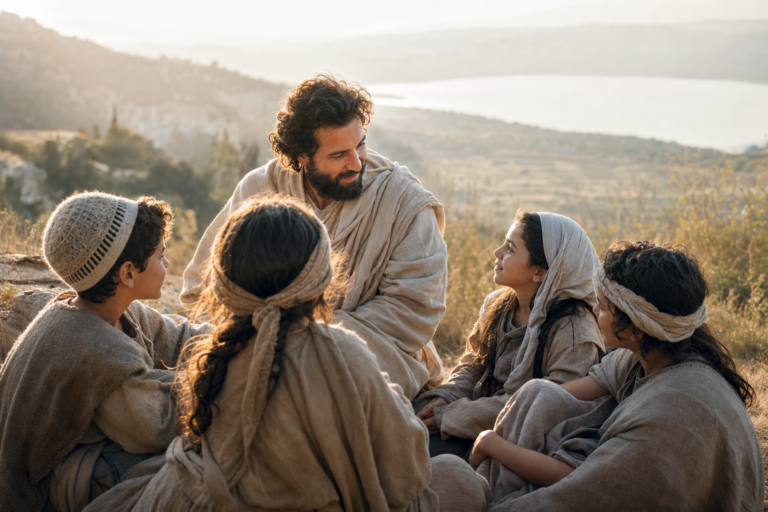
No moment in Jesus’s ministry declares more about how children should be received than when He rebuked His disciples for turning them away: “Let the children come to me; do not hinder them, for to such belongs the kingdom of God.” (Mark 10:14)
Before a child can prove their honesty, Jesus blesses and embraces them. He does not set up a test of worthiness, or make welcome conditional on good behavior. In Christ, belonging is not held at arm’s length, but placed in a child’s hands—and arms—first. This is how an atmosphere forms where the truth feels safe to utter, even when it reveals the worst.
What Actually Changes Anything? The Heart of Welcome
You might be tempted to think: “But we have a loving home—yet our child still lies! Isn’t this just sin, needing more discipline?” Scripture does not deny sin’s power. But it does insist that sins are healed by much more than pressure: they are drawn out by the love of Christ, Who is truth incarnate, yet never uses the truth to push away. The very instincts to hide and to confess are shaped by the climate a child absorbs from countless small moments.
Repeated experience, not lecture, forms the expectation in your child: “When I am honest, I am still wanted.” Over months and years, welcome and confession practiced together rewire your child’s automatic response. They learn honesty is not performance for acceptance—but a gateway to deeper trust and peace.
Making Honesty Safe: Practices That Rewrite the Script
- Model small confessions first. Let your child hear you name your own mistakes—”I snapped at you when I was hungry, and I’m sorry.” Before you ever ask for their honesty, show what welcomed confession looks like.
- Create a ‘truth-telling table.’ Establish a family ritual—perhaps at dinner or bedtime—where everyone shares one hard truth or failure from the day. After each, practice naming forgiveness or giving a gentle touch. No shaming, no fix-it-now pressure. This subtly teaches: here, honesty is met by connection, not withdrawal.
- Respond to confession with welcome first. When your child admits a wrong, offer a warm gesture or validating word: “I’m really glad you told me.” Only after comfort, talk about consequences. The sequence matters—the heart hears what comes first.
- Tell stories of risky honesty met by grace. Read Bible stories like David’s confession or Peter’s restoration. Share real family moments where telling the truth was hard, but led to relief instead of regret. Gospel-shaped stories build expectations about how God and His people handle failure.
- Recall Christ’s reception out loud. Regularly remind your child—especially in hard moments—that Jesus welcomes children as they are. His love is not canceled by mistakes. Tie every family practice back to the way of Christ, so children see the connection: “This is why our family welcomes truth—we are learning from Jesus.”
Immediate and Generational Impact
These practices do not change everything overnight. But day by day, they lay down new tracks in the heart. A child whose first memories of confession are relief, comfort, and forgiveness is a child more likely to run toward the light, rather than shrink from it.
This is not just affective safety; it is spiritual formation. In Christ, truth and welcome are never at odds. When a family’s patterns echo this, children learn by lived experience: “Honesty isn’t risky here—it’s the way home.”
The Vision: Homes Where Honesty Is the Pathway to Belonging
Picture a child, hands sticky, eyes searching yours—not bracing for rejection, but remembering comfort. Imagine the legacy: children, and their families, who pass on the reflex that truth can be spoken, because the first answer is always love shaped by Christ. Not avoiding consequences or permitting sin, but restoring each other after every fall.
That is how honest confession, met with Christ’s welcome, moves a family from patterns of anxiety and hiding, to a culture rooted in mercy and truth. These children don’t only grow to be honest; they grow to become agents of welcome—to siblings, friends, churches, and the next generation. That’s the power of a Christ-anchored home, where honesty is not the price of belonging, but its proof—and its fruit.